2016 Mazda3 “S” 5-Door Grand Touring Hatchback

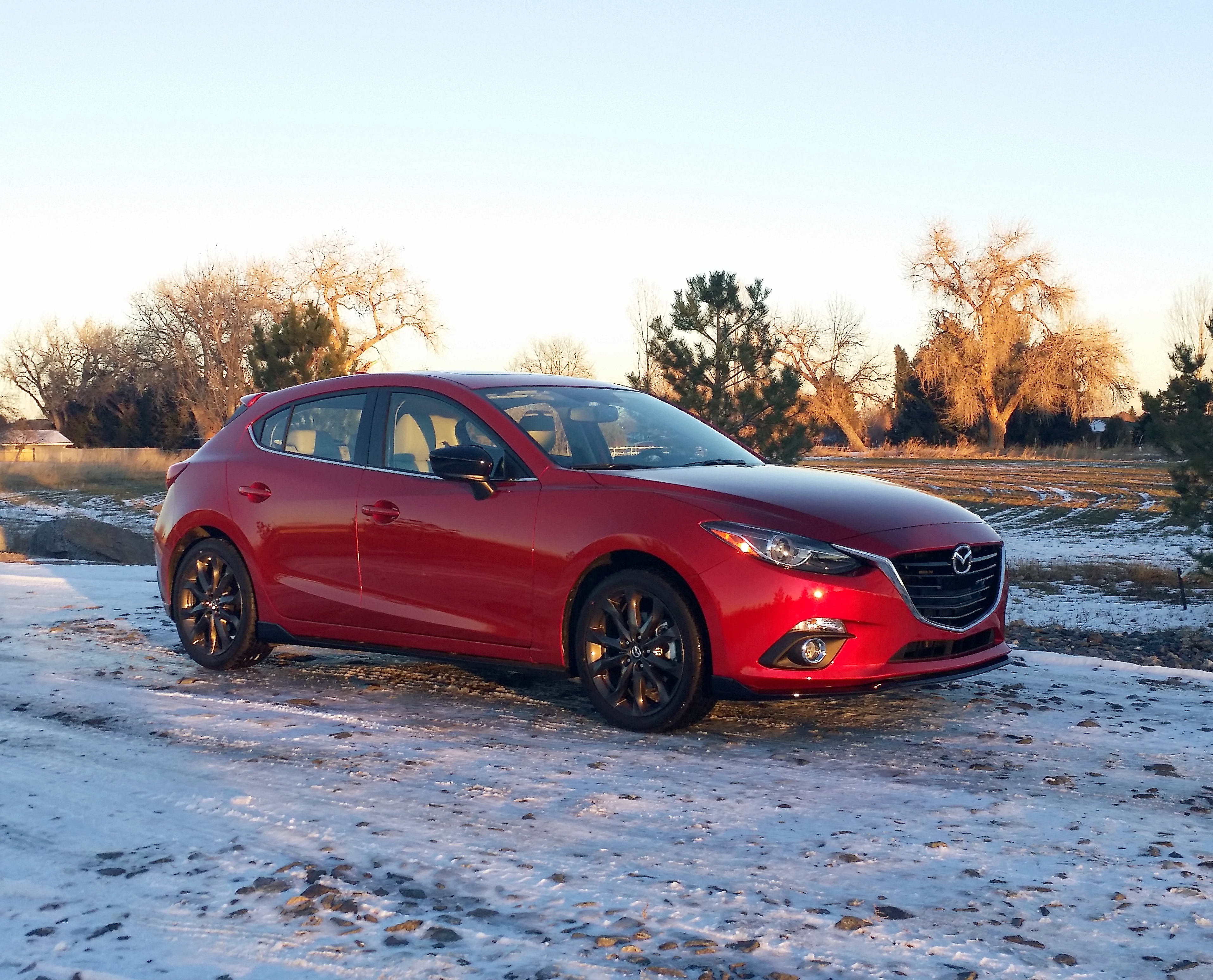
20151202_161511The first Mazda3 that could be purchased was the 2004 model, and the 2016 recently was introduced in a third generation configuration.  The Mazda3 was loaned to me for testing recently by Greeley Mazda, and it came in Soul red metallic paint with a black and almond leather interior.

At the same time as the Mazda arrived, the January, 2016 issue of Car and Driver magazine arrived, and in it was the Mazda3 designated as a “10 Best Cars for 2016” selection.  The test car that I received was the top-of-the-line Grand Touring S edition with an M.S.R.P. of $30,270.00.  The base price was $26,495.00, and to it was added several options that totaled $2,955.00, most notable among them being an appearance package for $1,750.00.  In the package was a grouping of spoilers and side sill extenders that actually added nicely to the appearance of the car.

As a Grand Touring Mazda3, my loaner had a moon roof, heated front seats, power driver seat, navigation/rear camera setup with 7” touch screen, 20151202_162227and a Bose 9-speaker surround sound stereo. Additionally, the Mazda was equipped with XM radio, a console-mounted command control for the infotainment system, blind spot monitor, proximity keyless entry, and power windows/locks/outside mirrors. A genuine “hand brake” and push button (plus remote) starter, always positives for me, were on hand in the attractive Mazda interior.  Also, the Grand Touring model features auto on/off bi-xenon adaptive headlights, LED combination taillights, LED daytime running lights, rain-sensing windshield wipers, auto-dimming rearview mirror with Homelink®, and perforated leather-trimmed seats.
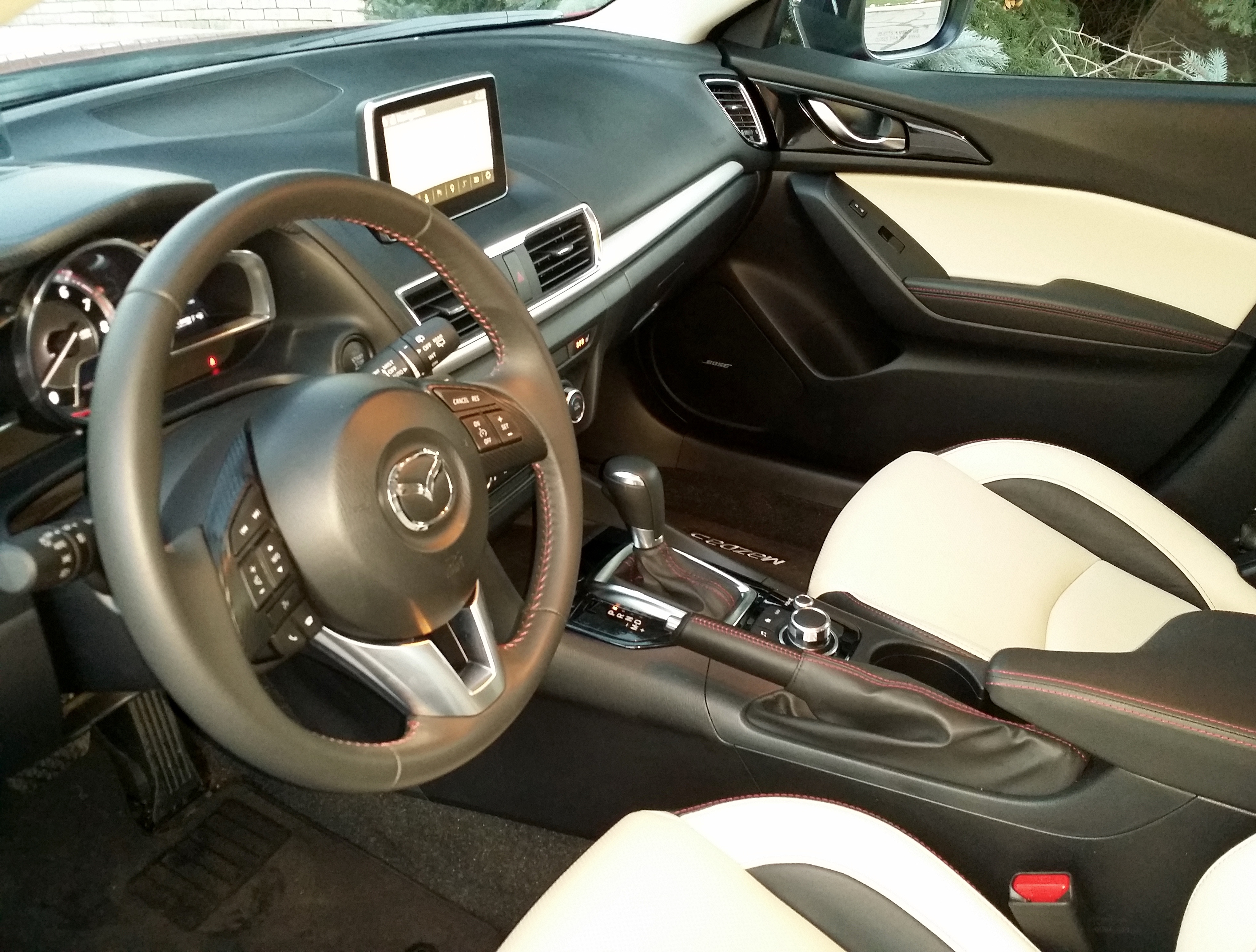
Power for the Mazda3 S is supplied by a 2.5 liter, four-cylinder, 184 horsepower (@ 5,700 rpm), 185 lb. ft. torque rating (@3,250 rpm) engine coupled to a six-speed automatic transmission with floor shift and paddles on the steering column. Reportedly, zero to 60 timing for the 3 is 7.4 seconds.  Fuel economy ratings are 27/city – 37/highway, and 31/combined miles per gallon. Mazda equips this drive train with what is called SkyActiv technology, a combination, among other things, of 13 to 1 compression ratio and direct, multi-hole fuel injectors. Therefore the EPA highway readings are excellent, with my observation coming in at above the 31 mpg combined number.
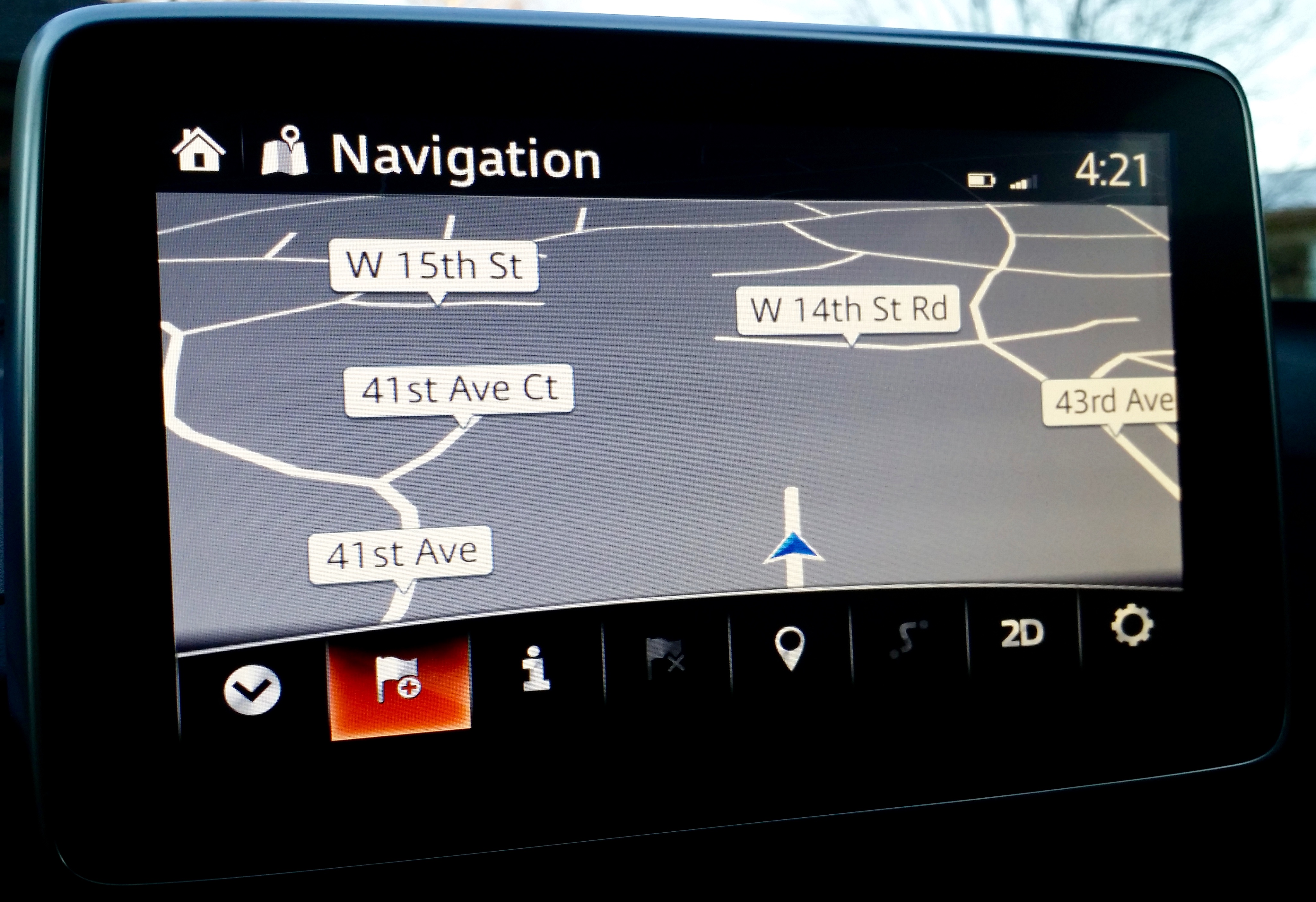
20151202_162141Styling of the Mazda3 Grand Touring S, introduced in 2014, features a longer hood and elevated trunk lid with aerodynamic spoiler attached. All four windows roll down out of sight, and the windshield has an impressive rake to it. Wheels are ten-spoke dark gray alloys fitted with P215/45R18 all-season radials, and the new grill has a more menacing, blacked-out customized look.  I gave high marks for the ride, handling, and guidance of the car, and adjusting the sound system and navigation is easy with the right hand on the command control arrangement.

The Mazda3’s handling is improved by virtue of the electric-assist power steering, MacPherson strut front suspension and multi-link rear suspension (a rarity in this class). The car is 180.3” in overall length, with a wheelbase of 106.3” and weight of 2,848 lbs. The fuel tank holds 13.2 gallons and the trunk holds 12.4 cubic feet.
I liked the 2016 Mazda3 five-door hatchback, and could anticipate recommending a purchase to a prospective compact hatchback shopper.  And the new Car and Driver magazine editors agree with me.
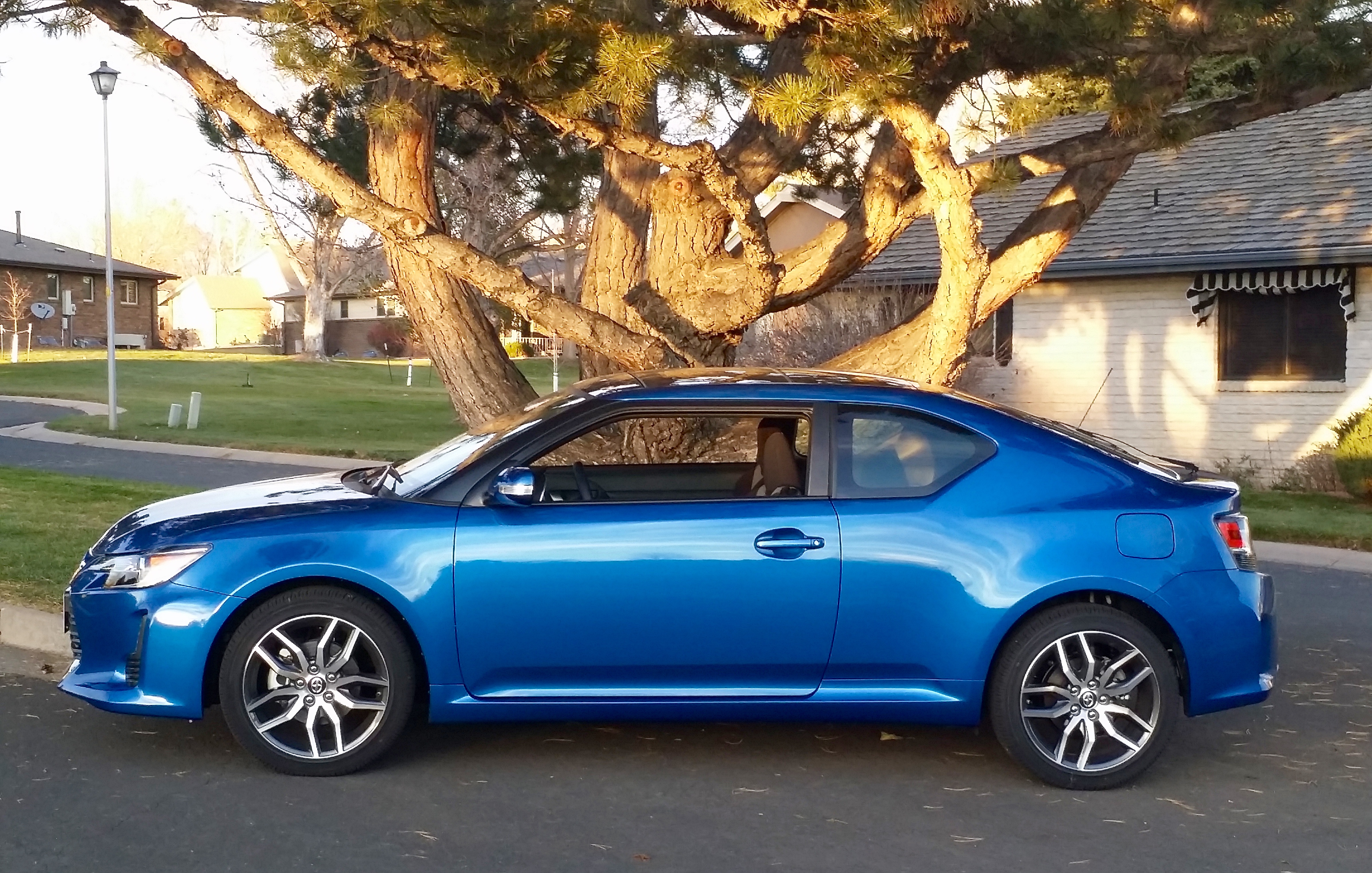


2016 Scion tC 3-Door Liftback

20151124_161413Scion automobiles are a product of Toyota (the Scion name means descendant of a family or heir), and were developed for the American market starting in 2002.  Last month I tested a Scion tC 3-door lift back that was delivered to me by Rocky Mountain Redline out of Dacono, Colorado.  Originally, the Scion lineup included the xA hatchback and xB wagon, and in 2004 they introduced the compact tC sports coupe like I drove, and the tC is now in its thirteenth year of production.  The paint was Blue Streak metallic blue, with black cloth bucket seats and five passenger seating.  It is an attractive sport coupe with extensive re-styling that took place two years ago.20151123_124926

My test tC had a 106.3” wheelbase and a chassis that was derived from the European-market Avensis sedan as well as the Lexus HS-250h.  Acceleration (0-60 in 7.5 sec.) is provided by the 2.5 liter, 4 cylinder, DOHC, dual variable valve-timed, in-line powerplant.  Horsepower is 179 and the torque comes in at 171 ft.-lbs.  Fuel economy of the tC with the 6-speed manual transmission computes at 23 mpg city, 31 mpg highway, and 23 mpg combined, with a 14.5 gallon fuel tank.  The front MacPherson strut and double-wishbone rear suspension gave me a sporty ride and smooth handling, and visibility and road noise are fine for a twenty-thousand dollar automobile.

Speaking of which, M.S.R.P. of the Scion was precisely $20,180.00, including all standard equipment and freight of $795.00.  Standard equipment included a glass tilt/slide moon roof, 8-speaker stereo with Bluetooth connectivity, pushbutton starter, power windows/locks, tilt/telescope steering 20151123_124706column, remote keyless entry, and cruise control.  The glass that runs the entire span of the roof presents a striking appearance, as it is a hatchback design without a package tray in the rear (you can peek in the 14.7 cubic ft. cargo area from outside).

Turning radius on the Scion is 18.7 ft., and the length is 176.6 in., making the handling and parking of this vehicle quite manageable.  Whenever I took the tC around the community, a lot of looks and questions were presented to me because of the car’s top-notch styling.  Males seemed to pay particular attention, which is good for Toyota because they are striving for 60% male purchasers.  The tC features 18-inch ten-spoke alloy wheels surrounded with 225/45R18 Yokohama all season radials.  Looks are enhanced with the bulging rear wheel-wells and the front grill that has a Lexus look to it, and on balance, the car is a solid alternative for the compact sporty car shopper.

2015 Infiniti Q50S 3.7 RWD Sedan

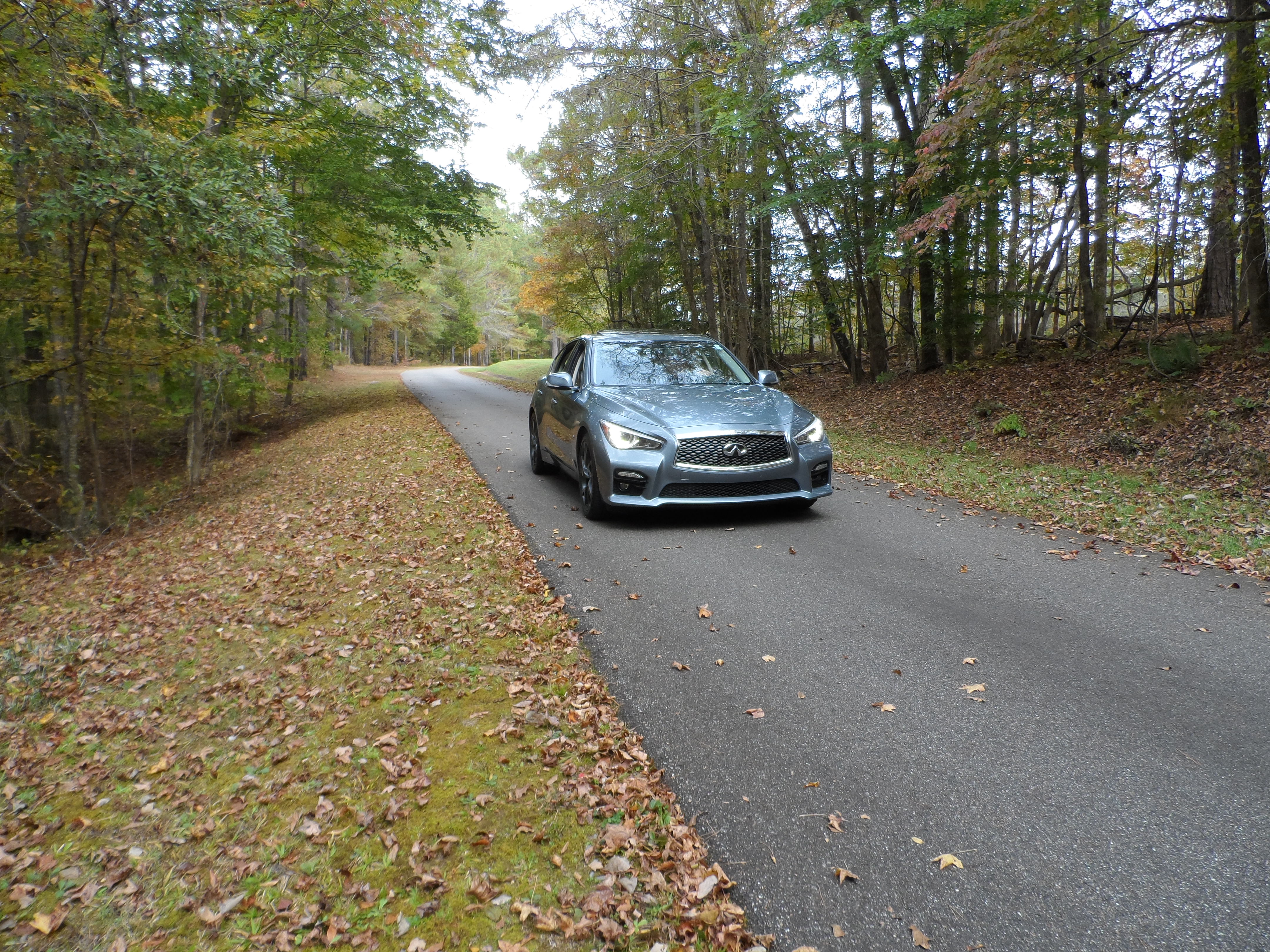
SAM_4142Ruth and I travelled to Alabama in October for the Camping World 500 at Talladega, Alabama, and while there tested a Hagane blue Infiniti Q50S.  Unlike the race, our trip and test ended pleasurably with a drive to Atlanta for the flight to Colorado.  Our stay was on Lake Martin in central Alabama, where in a lakeside cabin Hank Williams wrote “Kaw-Liga” – a reference to a lovesick cigar store wooden Indian – in 1952.  The number was included in Williams’ final recording session, and was placed on the flip side of “Your Cheatin’ Heart”, with both songs reaching Billboard’s number one position.  Hank Williams died January 1st, 1953, at age 29.

20151025_174521We enjoyed going through the Hank Williams museum in Montgomery, Alabama, but also had a good time for the first 500 miles of racing at Talladega on a temperate, overcast Sunday afternoon.  Nascar officials flubbed up the ending of the race, but by that time we had thoroughly enjoyed watching the proceedings and eating Alabama bar-b-que.  It was my third trip to the Talladega race, and the paddock arrangement behind pit road was great – we were there for nine hours.

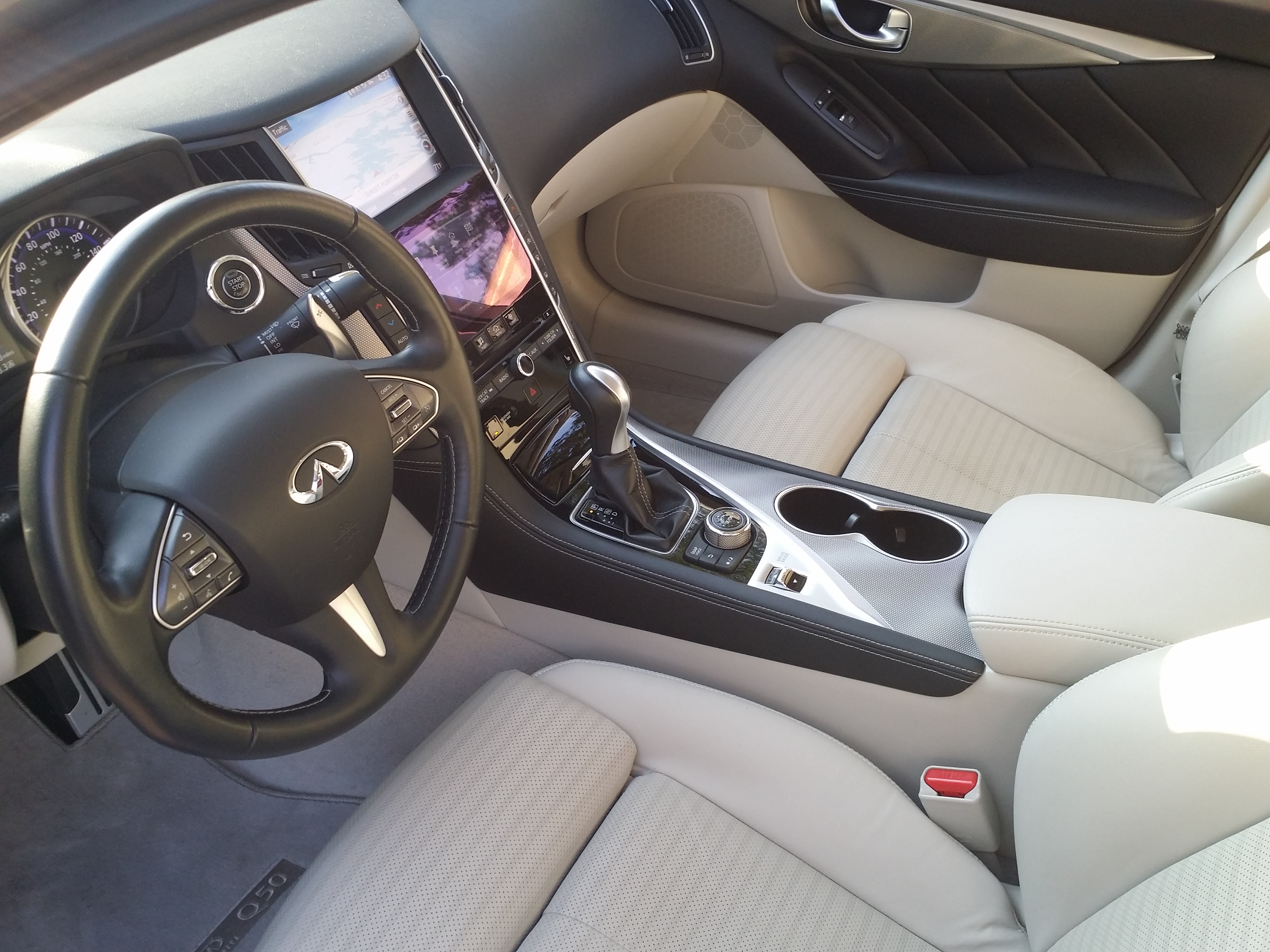
I have tested several Infinitis in the past, and this one seemed particularly suited to my taste – a high performance luxury Q50S sedan.  Its M.S.R.P. was $47,755.00, including freight, and that price included the following options – navigation package ($1,400.00) and performance wheel package ($1,800.00)  Thus, the car carried a base price of $43,650.00 and freight came in at $905.00.  The interior was sumptuous, and included a suede headliner, semi-aniline leather trim, Bose 14-speaker surround20151029_163210 sound stereo with satellite radio, tilt/telescope, navigation system, backup camera, moon roof, and heated front bucket seats.  The Stone (off-white) upholstery was striking with “Infiniti” stitching in the front buckets and soft double-stitched speedometer/tach hood.

20151023_155757The Q50S is a high performance car, with 328 horsepower and 269 lb. lb. of torque – it is a 3.7 liter V-6 with dual overhead cams.  It’s rear-wheel drive, the preferred architecture for a luxury performance sedan in this category.  The transmission is a seven-speed automatic (like the Infiniti V-8s have) with manual shift mode and paddles.  The driver selects from four driving modes with a console-mounted button – sport, standard, eco, and snow.  The eco mode maximizes fuel economy, and this car’s ratings are 20 city and 29 highway.  I observed 22.8 mpg during the time spent with the Q50S and that matches up with the EPA combined rating of 23.

The Q50S styling features chrome door handles, exhaust tips, and Infiniti signature grill.  The paint was “Hagane” (Japanese for steel) blue metallic, and actually looked best in sunlight.  The 19” alloy (RAYS branded) ten-spoke dark gray forged wheels were surrounded with P245/40R19 (front) and P265/35R19 (rear) summer radials.  Staggered tire sizes – that’s when the car owner knows that he has a performance machine.SAM_4147

The Infiniti was great to have possession of during the week of racing fun.  The Alabama roads are smooth, winding, and secluded in the tall timber.  This reviewer had fun with the Q50S, and it comes with my recommendation.


2016 Hyundai Sonata Hybrid Limited

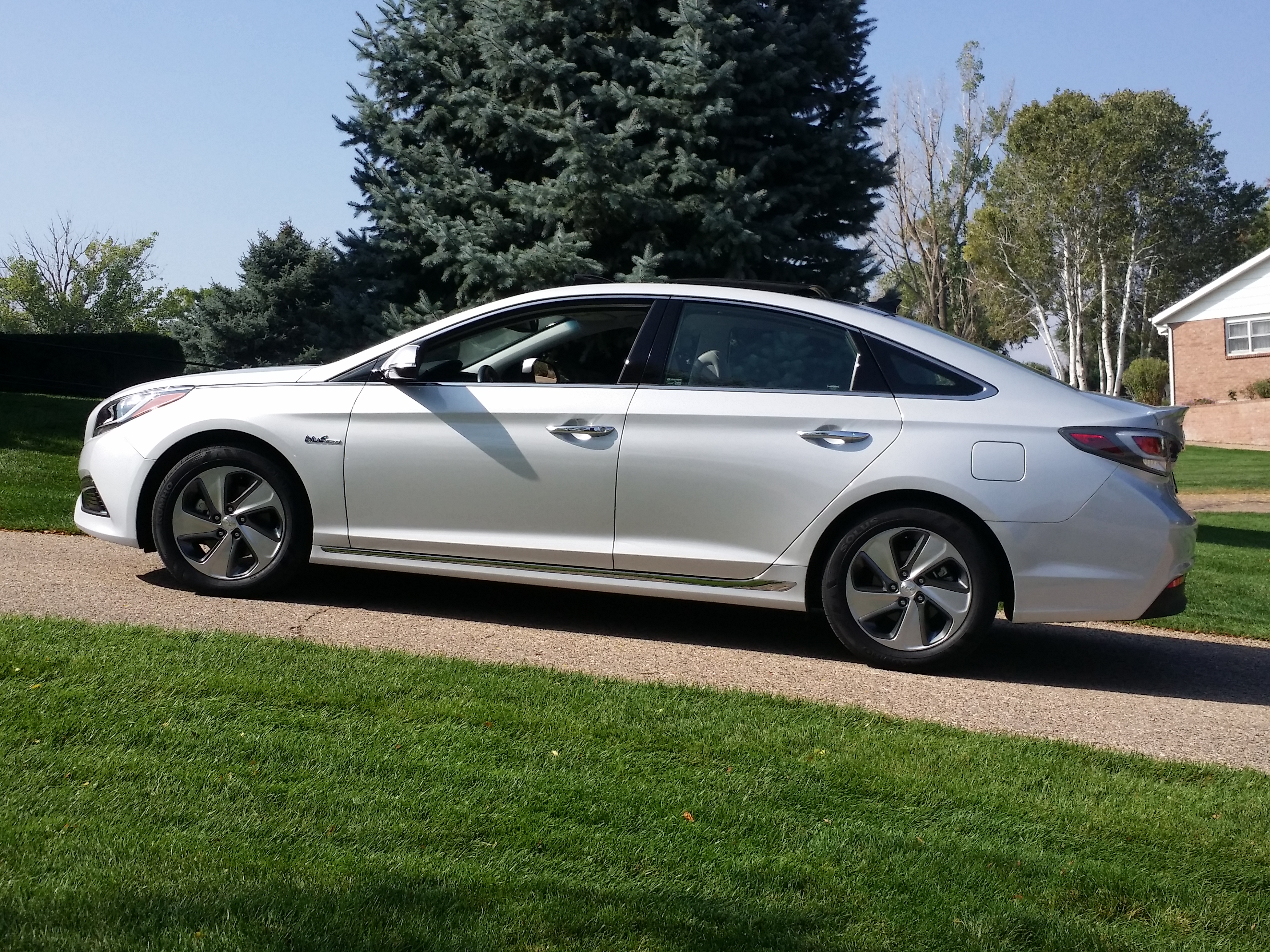
20151005_133532The Hyundai Sonata Hybrid has been on sale in America for about four and half years, and shares its drive train and some design elements with the KIA Optima Hybrid.  The two cars combine to occupy second place (in America) in hybrid sales to Toyota’s Prius.  The Hyundai has more conventional styling than a Prius, and in fact is an attractive sedan.  I received one for testing last week; a Starlight Silver unit with a gray leather interior.

The M.S.R.P. for my 2016 test unit was $35,765.00, freight included, and it was the top-of-the-line Limited model.  The options on the loaded Limited were a panoramic sunroof package ($4,500.00), carpeted floor mats ($125.00), and first aid kit/floor mats/wheel locks ($215.00).  Standard equipment on this model included heated front and rear seats, the leather (seating, steering wheel, and shift knob), 400-watt Infinity 8-speaker stereo, backup camera, navigation with 8” screen, power driver’s seat and eco-spoke alloy wheels.  Also on hand was tilt/telescope steering column, satellite radio, radar cruise control, power windows/locks/mirrors, pushbutton starter, keyless entry, Bluetooth/USB connectivity, navigation system, blind spot monitor, and heated mirrors with lighted signal stripes.

20151008_074546The hybrid power setup in the Sonata starts with a 2.0 liter, four cylinder gas engine and adds a permanent-magnet AC electric motor (total system power is 193 horsepower @ 6,000 rpm).  The car accelerates from zero to 60 in 8.4 seconds.  A six speed automatic transmission with a manual mode delivers power to the front wheel drive sedan.  EPA mileage ratings for the Sonata are 39 city/43 highway, 41 overall, and the fuel tank holds 15.85 gallons of regular gasoline.

As I mentioned, the Limited Hyundai is rather good-looking, with bold chrome strips on all four sides, chrome door handles, racy lighting on all corners, and two-toned “eco-spoke” gray alloy 17” wheels fitted with P215/55R17  Kumho Solus KH25 all season radials.  The Starlight Silver paint had some metallic in the finish, and the panoramic sun roof was evident from outside the car.

I spent a lot of time driving the Sonata around northern Colorado, and the ride was great.  Wind noise was minimal, and passing and accelerating from a light was a snap.  One thing that was quite balky was the gas gauge, which barely moved in a downward direction.

Weight of the Sonata is 3,560 lbs., not much for a hybrid.  The company uses a 270 volt lithium-polymer battery pack (warrantied for life), something normally found employed in a plug-in vehicle.  Thus, it is in the trunk, yet the trunk holds 13.3 cubic feet of luggage.  Wheelbase of the car is 110.4”, length is 191.1”, width is 73.4”, and the height is 57.9”.  With the battery in the trunk, the passenger volume is maintained at 106.1 cubic feet, like the Hyundai gas-powered sedan.

At the asking price of $35,765.00, I feel the Sonata Hybrid deserves a hard look from a perspective hybrid car shopper.  It’s attractive, roomy, fuel efficient, and well-appointed.

2015 Chrysler 300S AWD Sedan

20150907_063728The Chrysler 300S, a full-size luxury offering from Fiat Chrysler Automobiles, was introduced in early 2011 at the New York International Auto Show as a second-generation iteration.

The updated 2015 300 represents a nice improvement over its predecessor in terms of styling and technology.  The car is 198.6” long, weighs 4,029 lbs., and is intended to compete with popular cars like Chevrolet’s Impala, Toyota’s Avalon, and Ford’s Taurus.

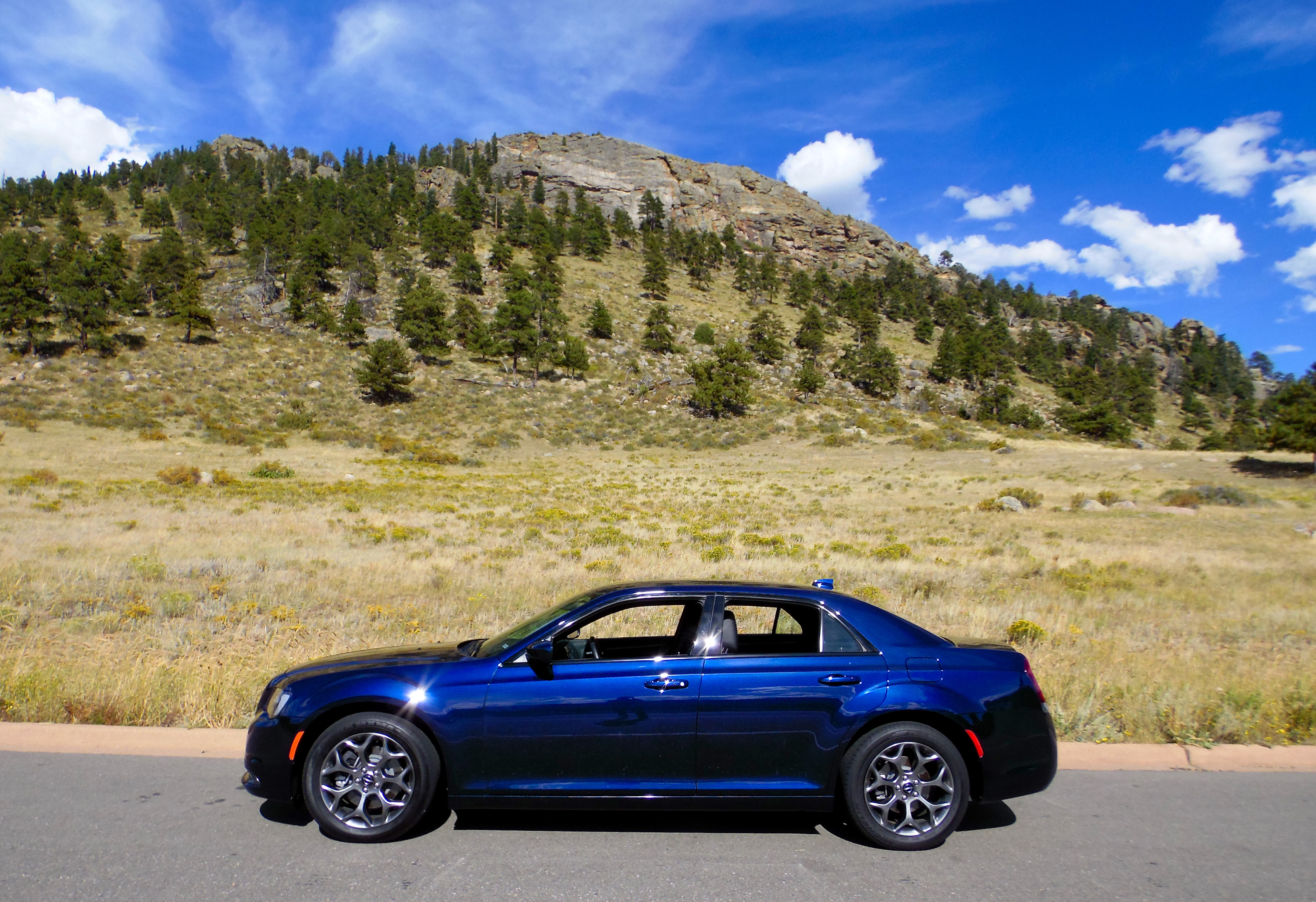
I recently tested a 300S “Sport” model with Jazz Blue pearl coat paint and black leather bolstered seating.  The “S” is third from the top in the line of 300’s, and this particular model had all-wheel drive.  Power was supplied by a 3.6 liter V-6 coupled with Chrysler’s proprietary 8-speed transmission.  The car exuded a throaty exhaust note and reportedly, the acceleration is zero to sixty in under six seconds.

Relative to its technology, the 300S that I tested had the navigation and BeatsAudio sound group, including a programmable driver dash cluster and 8.4” touchscreen display in the center stack. Chrysler calls its infotainment system UConnect, and with it the driver can command by voice the navigation route request, radio settings, text message(s), telephone calls, and recorded voice memos.  Hands-free responses to incoming text messages can be pre-defined by the driver (perhaps “I’m on my way.”), and the smart system technology can be trained to better recognize the driver’s voice in three languages, if desired.  Chrysler likes to say that their UConnect system takes non-distracted driving very seriously.SAM_0769

Driving the 300S was pleasurable, with handling, ride, road noise and guidance all impressive.  A blind spot monitor, cross path detection, and backup camera system all made driving easier, as did the comfort group with its heated steering wheel and seats.  A rotary E-shift gear selector was nice, and it’s something that I have come to look forward to when I encounter it in the test cars that I analyze.

Chrysler has a hit on its hands with the 300 series sedan, have sold more than 53,000 in 2014.  I can see why it is so popular, and really enjoyed my week driving the “S” model.

2015 Chrysler 300S specs

MSRP: $39,560.00, including freight and; customer preferred package -UConnect 8.4” screen, navigation, and HD radio ($995.00).

Power: 3.6 liter (217 c.i.d.) V-6 with 300 horsepower and 264 lb. ft. of torque. 8-speed automatic transmission with E-shift plus steering wheel paddles.  All-wheel drive.

Capacities: Fuel 18.5 gallons, cargo 16.3 cu. ft., passengers 5

EPA ratings: 18 mpg-city, 27 mpg-highway, 21 mpg-combined

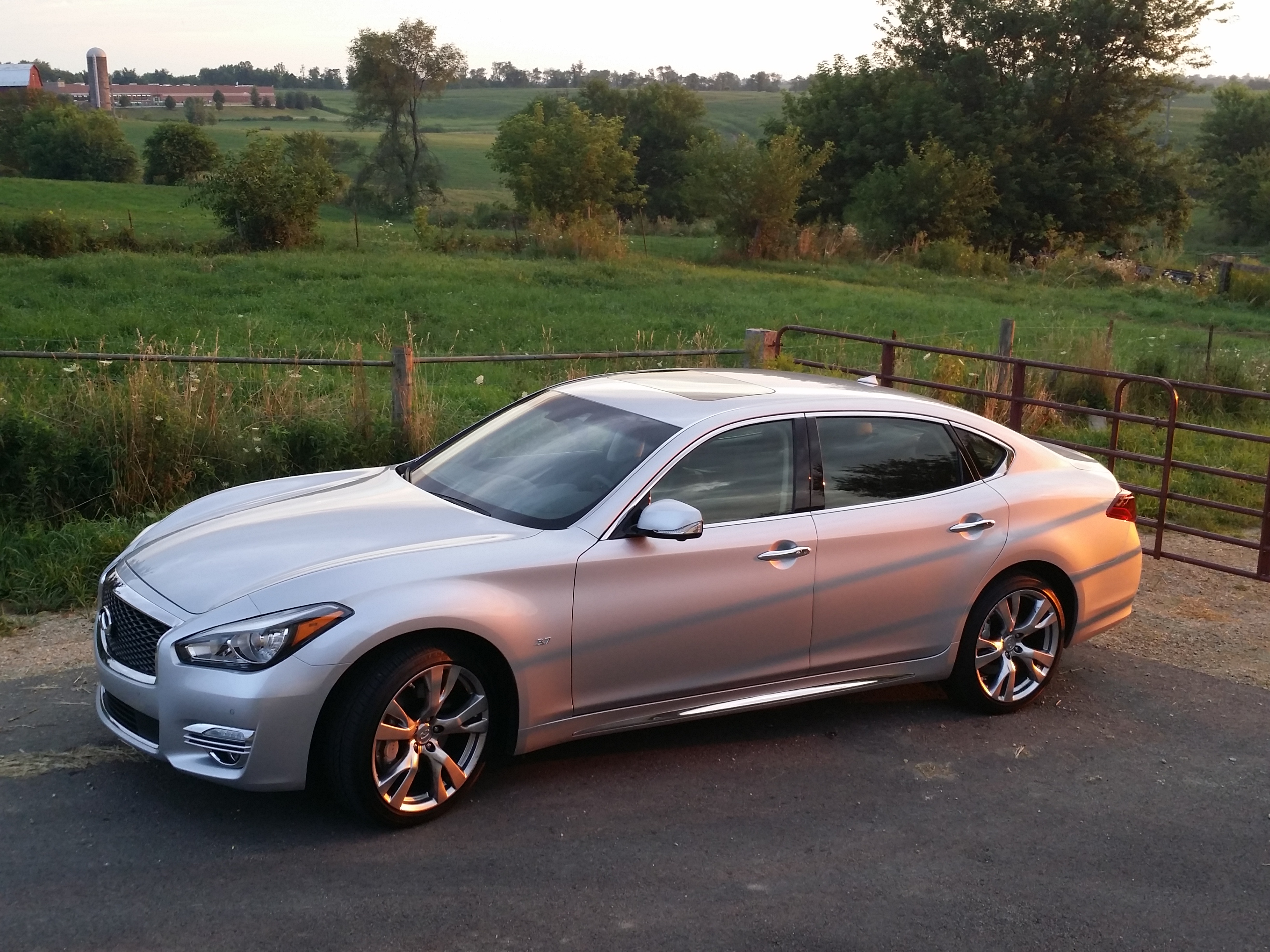
2015 Infiniti Q70L 3.7 Sedan

20150726_060124

Infiniti is the luxury automobile division of Nissan Motor Company, and has been selling cars and light trucks in North America since 1989.  The history of the company goes all the way back to 1914, when the first “Datsun” was produced in Tokyo.  The Datsun name was subsequently changed to “Nissan”, and the company sells over 5 million vehicles each year, worldwide. The Infiniti models were rolled out concurrently with Honda’s Acura and Toyota’s Lexus lineup;  Japanese government-imposed export restraints at that time made it more profitable for auto manufacturers to send us more expensive cars.

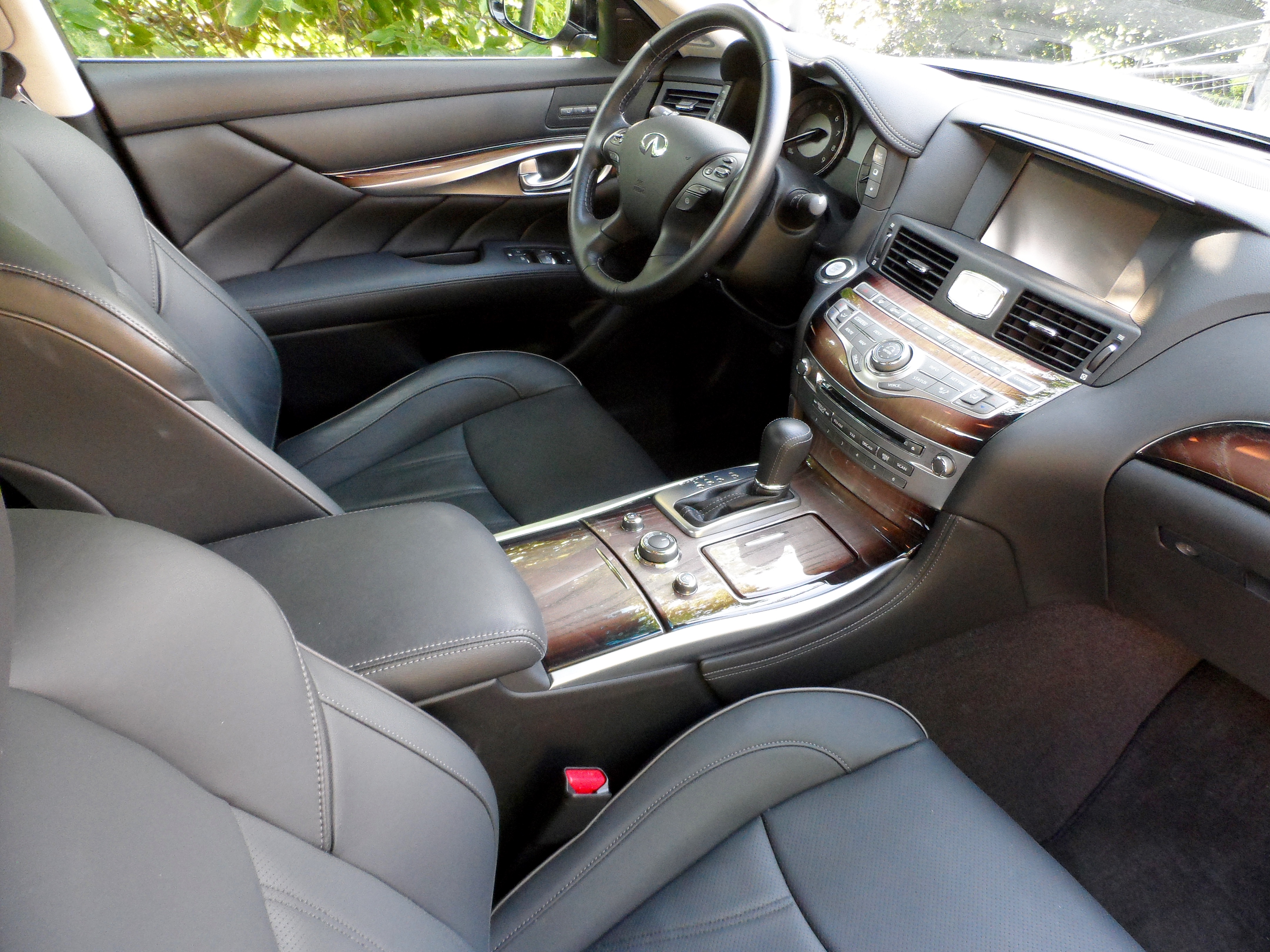
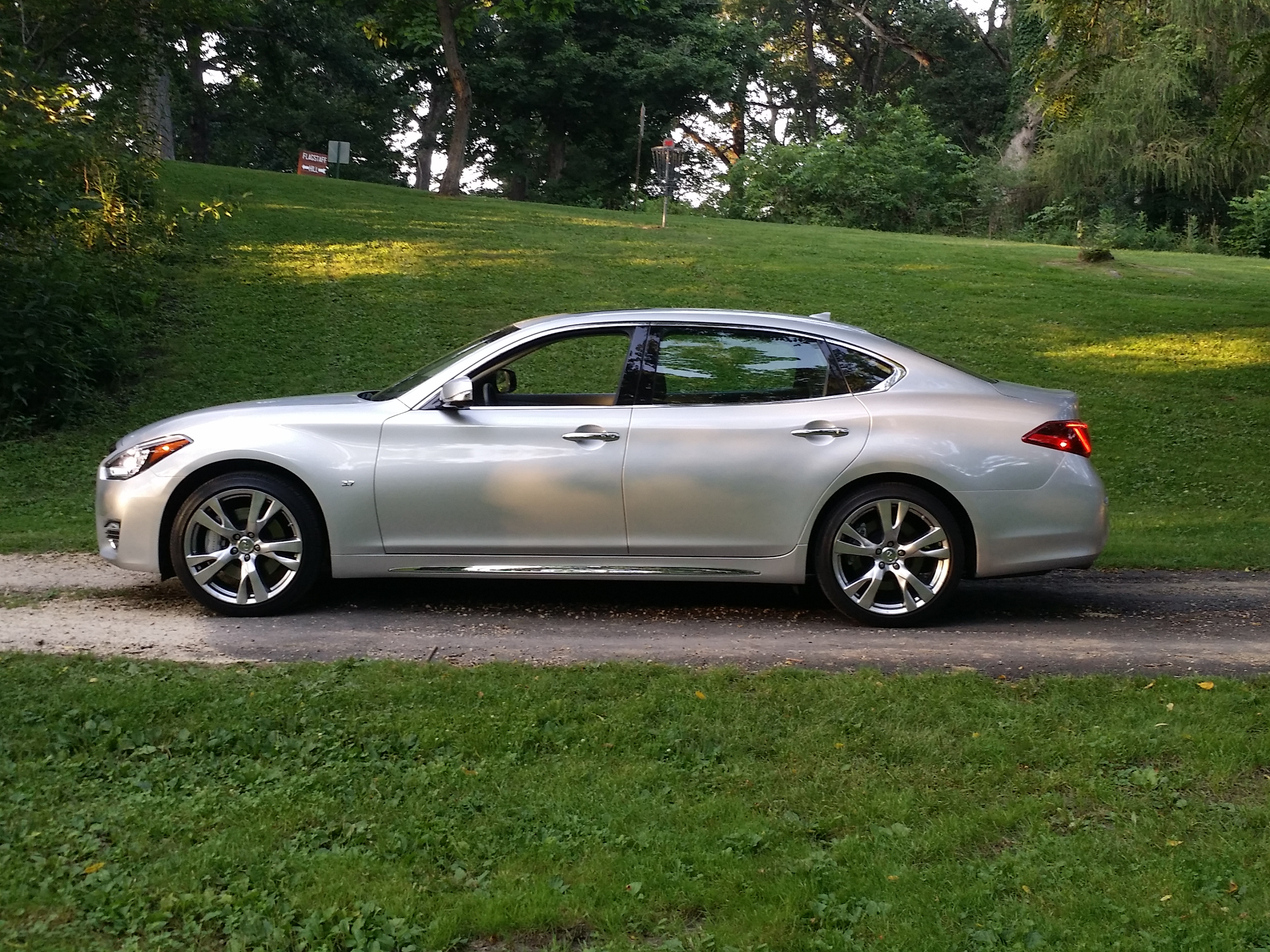
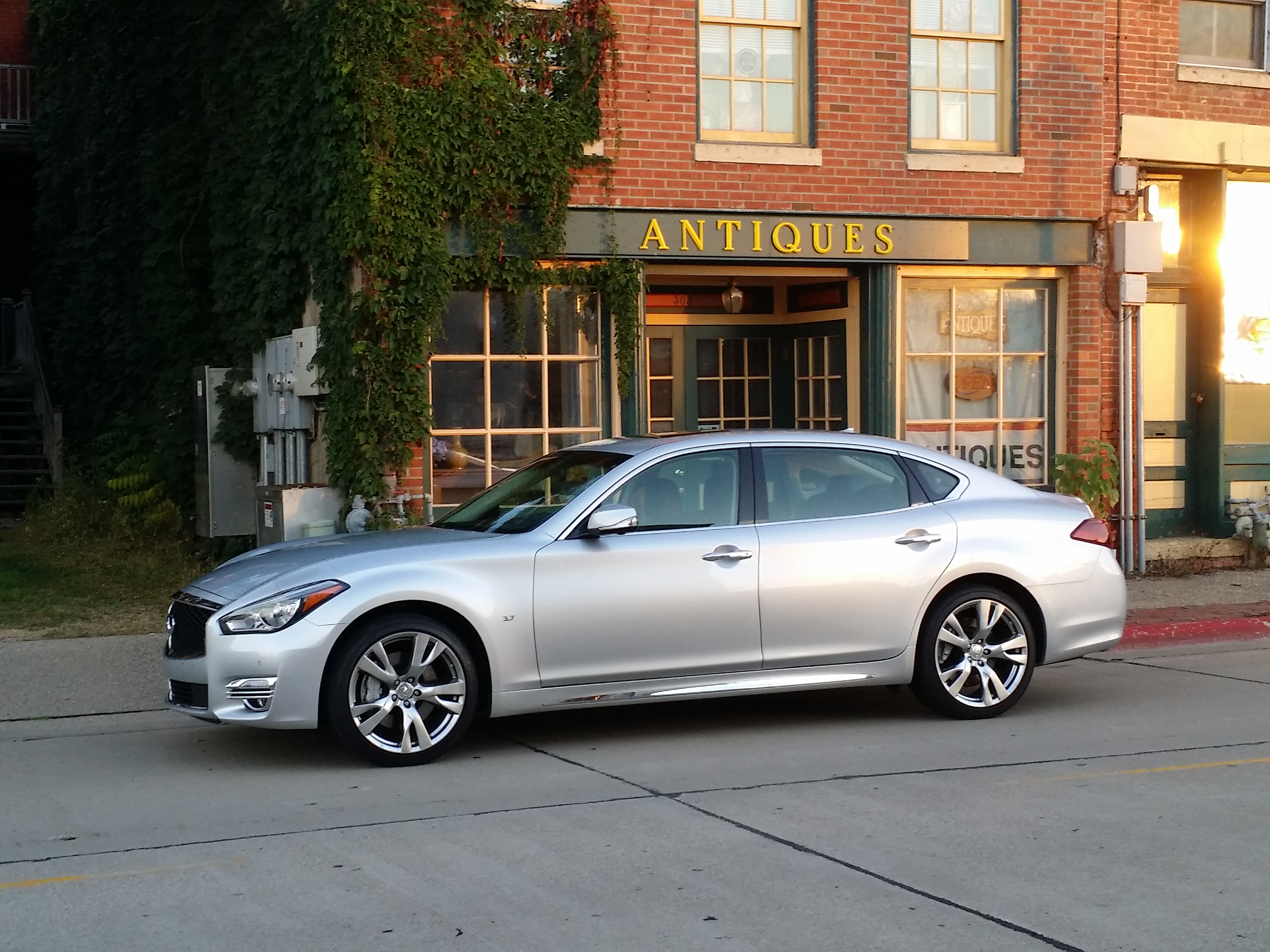
Although at the turn of the century Infiniti nearly became extinct, the lineup has been rejuvenated and today their cars are highly thought of, one of the models SAM_4111being the 2015 Q70L, a high performance, rear-wheel drive four door sedan with V-6 power.  A Liquid Platinum silver Q70L was waiting for Ruth and I at Chicago’s O’Hare International airport recently and I had the pleasure of wringing it out for a few days in western Illinois.  Inside it had sumptuous Graphite leather seating and Japanese white ash (real) wood trim accents.  It’s a five passenger car with terrific (heated and air conditioned) bucket seats and room for three in the back – heated seating, as well.  All the occupants can be comfortable because as an “L” offering, the car has 6″ additional interior space, specifically in the rear passenger compartment.  As a loaded car it contains the things you would expect as such; heated/tilting/telescoping steering wheel, ten way power buckets, all-around parking/blind spot monitor, power moon roof, push button ignition, dual zone climate setup, Bose 2-channel, 10 speaker audio, 8” VGA color touch-screen navigation display, radar cruise control, and USB/Ipod connections.   M.S.R.P. for the Q70L that I drove was $60,605.00, which included the base car ($51,350.00), deluxe touring package ($3,900.00), technology package ($3,300.00) 20” alloy wheel package ($1,150.00), and freight of $905.00. 20150724_192608

20150727_061626 After looking over the Q70L at the airport, my wife and I headed for Galena, Illinois for the weekend.  I wanted to take U.S. 20 to check out the 330 horsepower (270 lb.ft. of torque) V-6 and seven speed automatic with manual shift mode. What a ride!  This machine has some giddyup and is a treat out on the road.  Also, when crossing rails or tar strips the car feels like a block of steel – no shudder, creaking, or shake.  Zero to 60  time is six seconds (3,957 lb. car) and the top speed, reportedly, is governor limited at about 135 mph.  Fuel mileage estimates are 18/city and 26/highway (20 gallon tank), and I averaged about 21 mpg running around northwestern Illinois.  Handling and ride are firm and compliant with real nice steering feel.  Bridgestone RE97as Potenza 245/40R20 radials are wrapped around the ten spoke polished alloys and chrome is on hand both at the lower rocker molding area and on the door handles.  It’s a good looking car.

Once again, I have fallen in love with a car and have failed to register a complaint in the review.  So before I let the big Q go, I’ll mention that the ample space in the rear passenger compartment was so enticing to my mother-in-law that it became necessary to ride all over the countryside with her on board.


2015 Lexus RC-F RWD 2-Door Coupe

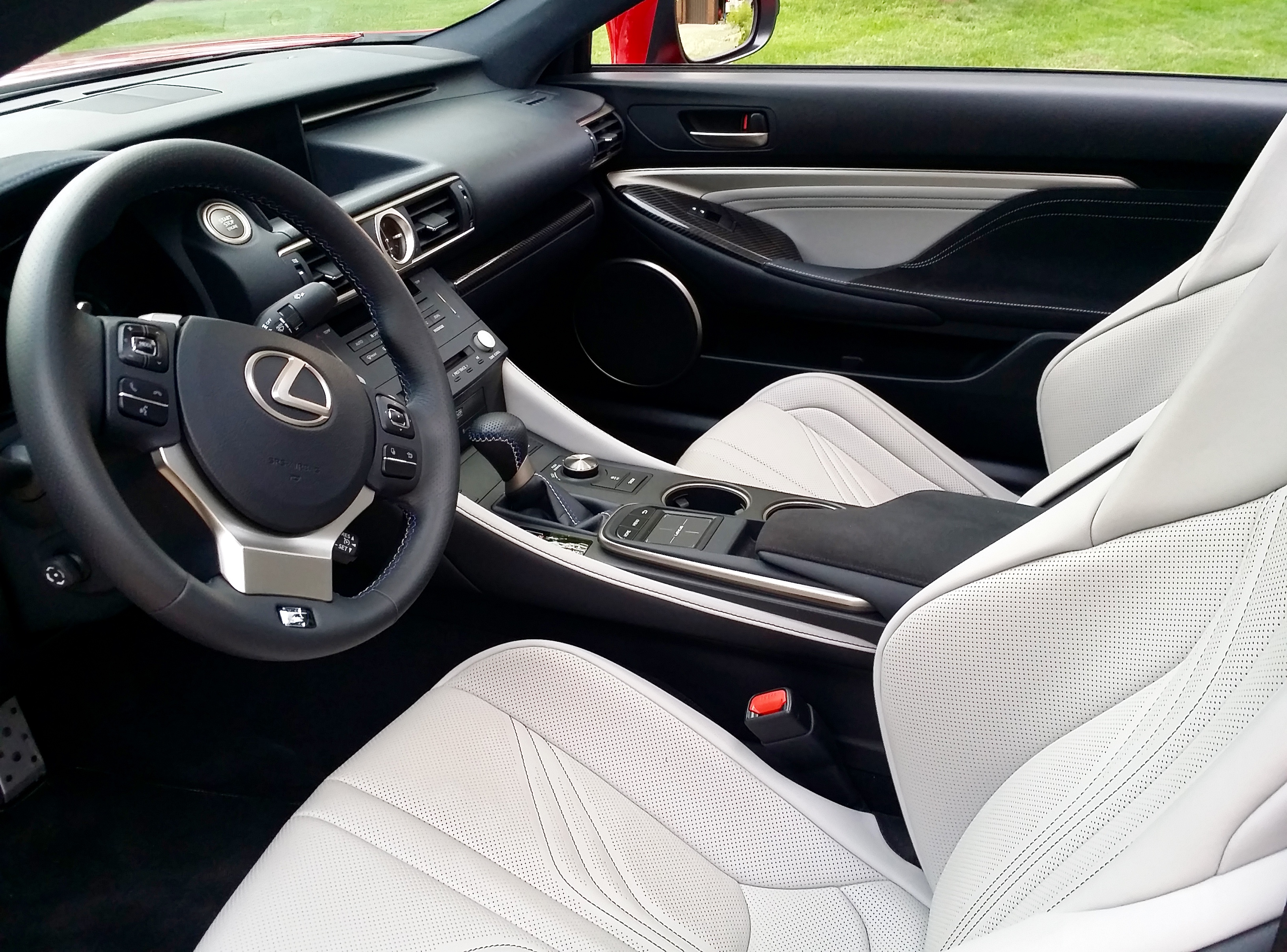
20150608_185153In late 2014, Lexus brought out their high-performance version of the RC Coupe, the RC-F, as a 2015 model offering.  The RC-300h and RC-350, the original V-6 coupes, were upgraded to a V-8 in this new car, a 5.0 liter, 90 degree, four-cam power plant.  The RC-F is essentially a blend of three prior Lexus models – GS and IS sedans and the IS-C convertible.  What the amalgamation resulted in was what I called a “supercar” all week long during my testing of the RC-F.

In a pleasant turn of events, on several occasions nearby motorists, upon blowing their horn, were seen giving me and Ruth a “thumbs up”, as opposed to the customary shaking fist.  They must have agreed with me as far as the “supercar” characterization goes, and admittedly the Infrared paint and terrific styling makes getting around in obscurity quite difficult.  Lexus likes to say “you’ll turn heads” with the RC-F, and indeed we did.

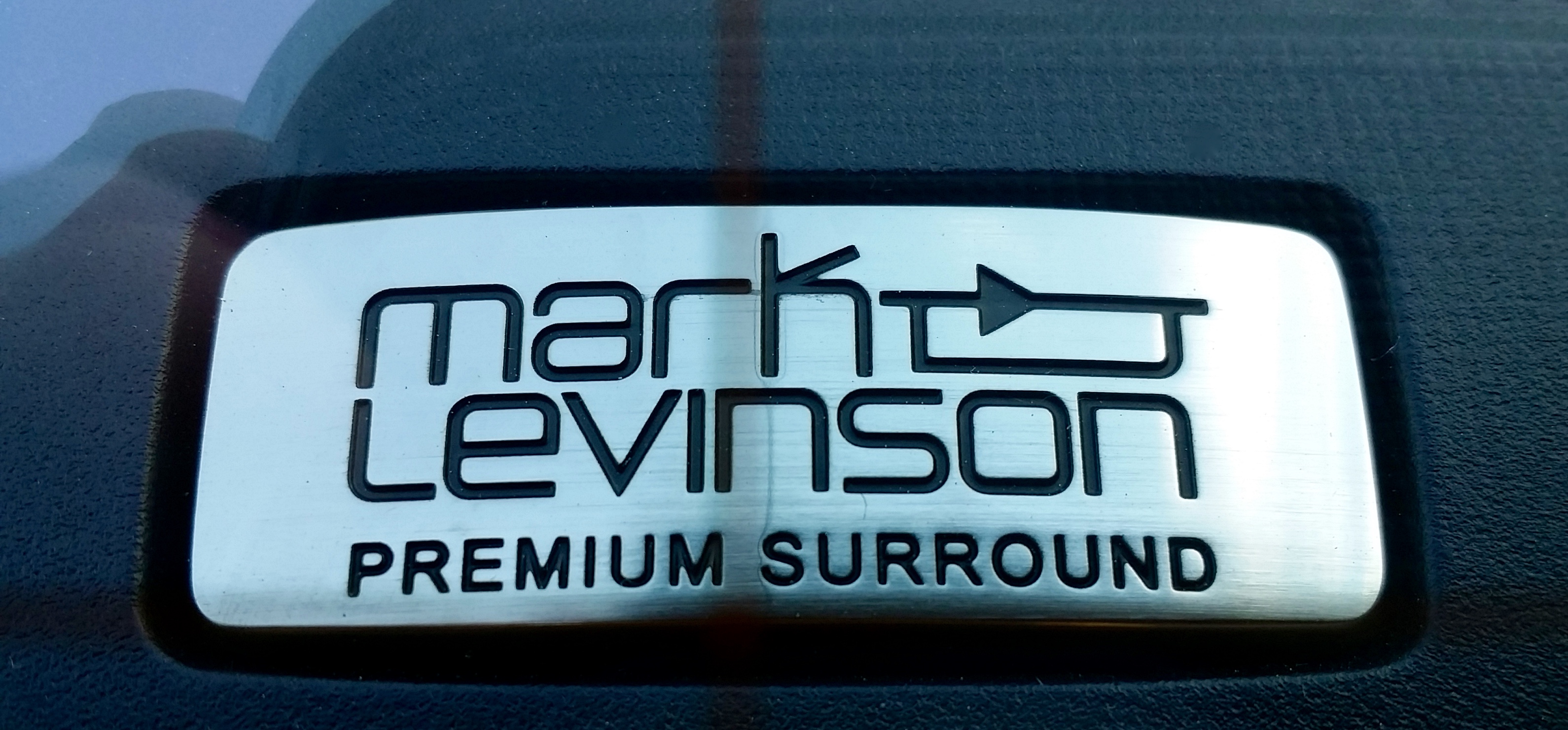
M.S.R.P. of my test Lexus came in at a total of $74,560.00, including freight.  The base price ($62,400.00) had as options the following: 19″ hand polished alloy wheels ($1,500.00), leather interior ($800.00), navigation package ($2,840.00), the paint ($595.00), premium package ($4,400.00), and moonroof ($1,100.00).  Thus the four passenger RC-F was equipped with pretty much every imaginable interior amenity including the Mark Levinson rock-crushing, 835-watt, 17-speaker surround sound audio system.

20150614_085919

The RC-F has a fairly smooth drag coefficient of .33, and reportedly has a top speed of 168 mph.  On the dashboard is situated a tennis-ball sized, 200 mpg speedometer and a rather large 9,000 rpm tachometer.  A rating of 467 horsepower from the throaty V-8 is at an impressive 7,100 rpm, and the torque rating is 389 lb. ft. at 4,800 rpm.   Four driving modes are available on the console-mounted knob of this car –  Sport S mode alters the powertrain for more dynamic throttle response, Sport S+ mode adds steering enhancements to help provide a higher level of responsiveness, normal mode provides the optimal balance of fuel efficiency and engine performance, and ECO mode moderates the throttle response, engine power output and climate settings for increased fuel efficiency.  My favorite was, of course, the Sport S+ mode, and even Ruth urged me to make the selection when we rode around together.  Part of the reason for our desire to drive in that mode was the active sound control that Lexus installs – at engine speeds up to 3,000 rpm, the system issues a steady tone of low and deep sounds.  And as the engine speed increases, the tone transforms into a higher-pitched note that blends with the engine’s mechanical sounds, and it really honks above 6,000 rpm.20150611_05594520150614_090048

The RC-F transmission is an eight-speed sport direct shift automatic that is smooth operating in normal and Eco modes, and more abrupt in the two sport modes.  Paddle shifters are on hand and the two-door coupe has rear wheel drive with a Torsen limited-slip differential.  Zero to sixty acceleration is reportedly 4.5 seconds. Wheelbase of the RC-F is 107.5″, overall length is 185.2″, the trunk holds 10.1 cubic feet of luggage, and the weight is 3,958 lbs.  It is the same size as Ford’s Mustang and about 200 lbs. heavier.20150614_090119

I averaged 20.3 miles per gallon with the Lexus, and provided it with its called-for premium gasoline.  The tank holds 17.4 gallons, and the EPA ratings are 16-city, 25-highway, and 19-combined miles per gallon.  Purchasers of the Lexus RC-F don’t care about the information in this paragraph, but do care about the rocket-ship performance and dynamite styling of it.  This reviewer could recommend a long look at the RC-F if that is the twin desires of their purchase.   20150611_060048


2015 Subaru BRZ Series.Blue RWD

SAM_4073Subaru and Toyota joined forces a few years ago to produce a rear-wheel drive sports car and in 2013 they introduced what Subaru named the BRZ.  Subaru provided the engine for the unit and even landed the job of producing the car for both companies.  The Subaru name (BRZ) denotes boxer engine (B), rear-wheel drive (R), and Zenith (Z), which means a point in time when something is most powerful and successful.  Toyota put out their sports car with a Scion nameplate and named it the FR-S.

I found a 2015 BRZ Series.Blue in my driveway last week courtesy of Rocky Mountain Redline, and the driver came to the door with the keys.  Actually, I didn’t need the keys in my hand when I left the neighborhood because the Subaru has “keyless access and start”, allowing you to enter and drive with the keys in your pocket.  This BRZ had the big red “STI” starter button because of its designation as a Series.Blue, a limited production model (limit, 1,000), with a lot of other special equipment on hand, as well.SAM_4065

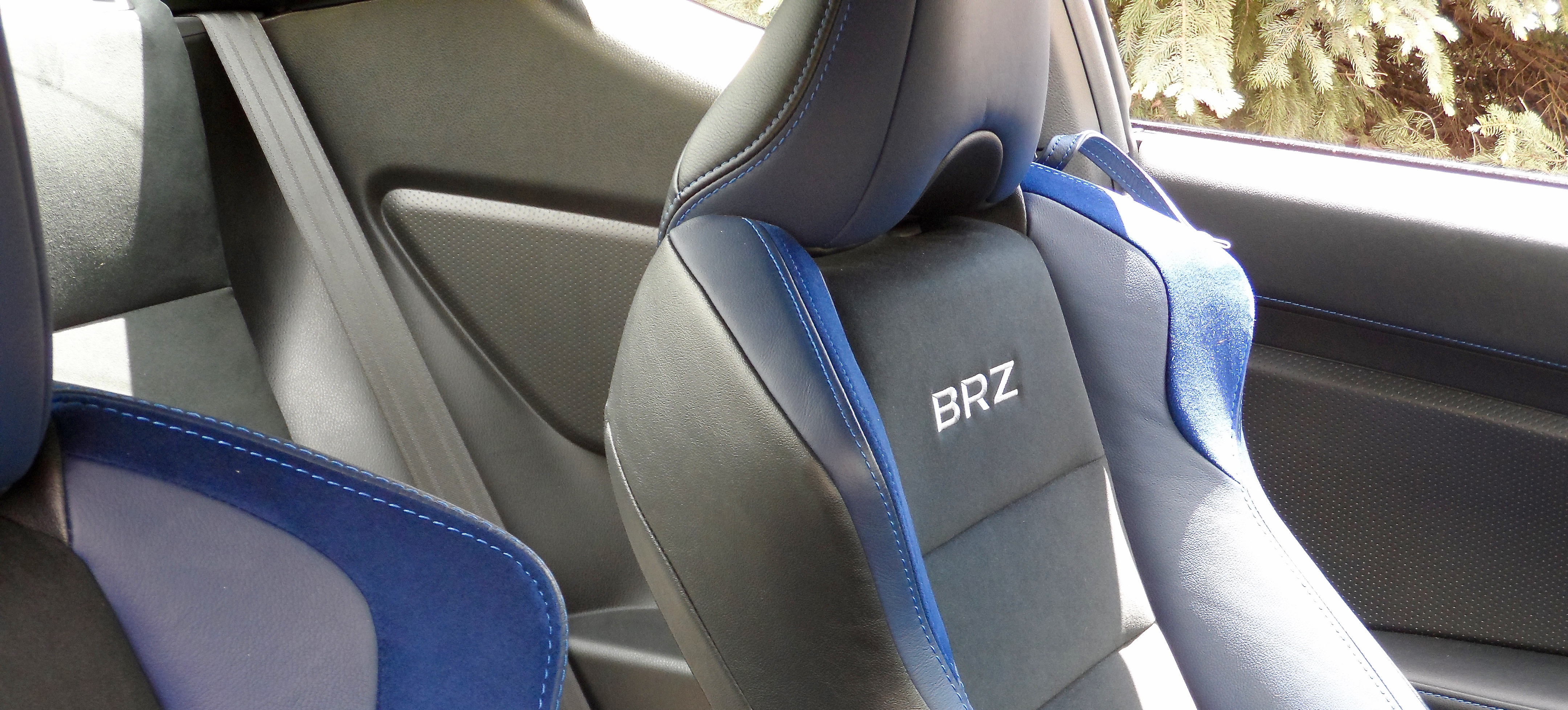
Subaru has built 500 of these WR Blue Pearl metallic BRZ’s (they are done), and 500 Crystal White Pearl ones.  All of them have as upgrades the following items:      black STI front, side, and side-rear under spoilers for keeping the BRZ well-grounded at high speeds, red-finish brake calipers that can be seen between the spokes of the wheels, special 15-spoke black painted STI wheels, and the special red illuminated engine start/stop button.  Also, the car sports leather and Alcantara upholstery featuring blue leather seat bolsters and head restraints. The unique color continues with Blue stitching accents on the seats and the blue and black leather-wrapped steering wheel, as well as the shift lever boot and leather-wrapped parking brake handle.

Interior appointments of the Subaru included audio/navigation system, cruise control, heated front seats and mirrors, power windows, Bluetooth phone connectivity, and AM/FM/XM/CD radio.  Ruth and I drove to Denver and back in the car and the seats did not annoy, the guidance on the highway was great, and road noise was suitable for such a car.SAM_4064

The BRZ, trimmed-out as nicely as it was, still shines brightest on the road.  It is powered by a 2.0 liter, four cylinder boxer aluminum engine that provides 200 horsepower (@ 7,000 rpm) and 151 lb.-ft. of torque (@ 6,400 rpm).  The punch-counterpunch action of the boxer pistons in the Subaru cancel each other out and provide a smooth delivery of power.  Also, the horizontally opposed engine results in a lower center of gravity in the vehicle (18”), aiding the handling and cornering characteristics.  Porsche and Subaru are pretty much it when it comes to boxer automobile engines, and the design is found in some BMW and Honda motorcycles.  The motor was patented by Germany’s Karl Benz in 1896.  Fuel economy ratings on the BRZ are 22-city, 30-highway, and 25-combined miles per gallon.  The car burns premium unleaded gasoline, and the tank holds 13.2 gallons.SAM_4078

My test BRZ had a six-speed manual transmission, and what a pleasure it was to operate with a snick-snick short-throw shifter/linkage setup.  A sport-tuned suspension is installed along with a Torsen limited-slip rear differential and 4-wheel disc (11.5″) brakes.  Reportedly, the 2,800 lb. BRZ travels from zero to 60 in SAM_40636.4 seconds.  The black wheels are 17″ in diameter and are fitted with P215/45R17 Michelin Primacy HP summer radials.

M.S.R.P. for the Subaru was based at $27,695.00.  Freight and the Series.Blue package ($1,795.00) brought the total to $30,285.00.  Shoppers looking for a 2 + 2 sports car for around $30,000 with terrific styling and performance would be well-advised to look at the 2015 Subaru BRZ Series.Blue, if they can find one.


2015 Dodge Charger SXT AWD Sedan

This slideshow requires JavaScript.

I see that AutoTrader advertisements are featuring a number of Dodge Chargers, specifically the “General Lee” of Dukes of Hazzard fame, and several white, late-model four-doors similar to my latest test car.  It was a 2015 Dodge Charger SXT all-wheel drive sedan and was painted Ivory tri-coat pearl.  Inside it was Tungsten (gray) cloth sport upholstery with the front bucket seats both powered and heated.

The General Lee was a 1969 Dodge Charger driven by the Duke cousins Bo and Luke, in the television series The Dukes of Hazard. The car is known for its special horn, its high speed chases, stunts, long jumps, and for having its doors welded shut, leaving the Dukes to climb in and out through the windows.  The car’s name is a reference to the Gen. Robert E. Lee and it bears a Confederate flag of America (representing the army which Robert E. Lee commanded) on its roof, and also has a horn that plays the first twelve notes of “Dixie”.  On average, one General Lee Charger was used up per television episode, and legend has it that between 250 and 32o automobiles were destroyed during filming of the series.  Stunt drivers were known to enjoy the long jumps, but they reportedly hated the landings.

Shortly after the “Dukes”, the Dodge Charger was nonexistent for nineteen years before its re-introduction in 2006.  That’s when it came out as a four-door, rear-wheel drive sedan with styling that was supposed to harken back to the 60’s and 70’s glory days.  All-wheel drive has been subsequently added as an option to the car, and my test Charger was equipped as such.  The SXT model I drove represented the model sixth down from the Charger SRT Hellcat, one of five V-8 hemi-powered machines, and it sits atop the four V-6 models that the company offers.

Base price of my Charger was $32,995.00, and as options it had the fancy paint ($500.00), and navigation/backup camera ($995.00), so with freight of $995.00 the total M.S.R.P was $35,485.00.  I thought it was pretty reasonable, and some omissions responsible for the decent list price included the solid roof and the cloth seating.  But it was a quite attractive automobile and handling, guidance, ride and road noise level are were satisfactory to this reviewer.

Equipment on the SXT included remote engine start, hill start assist, XM radio, 8.4″ touchscreen for audio and navigation, 276-watt stereo, and Chrysler Corporations proprietary UConnect infotainment system.  Interior space amounts to 104.7 cubic feet and trunk space is 16.5 cubic feet.  The two spaces can be blended together by virtue of the 60/40 split-folding rear seatbacks.

Power for the Charger that I drove comes in the form of a 3.6 liter Pentastar V-6 with 292 horsepower and 260 lb. ft. of torque.  A Rally group, not present on my test car, pushes horsepower to 300.  My 292-horsepower Dodge was rated at 18 mpg-city, 27 mpg-highway, and 21 mpg-combined (EPA).  Observance of mileage came in at a respectable 24.5 during a week with the car.  Attached to the Pentastar was a Torqueflite eight-speed automatic transmission with a sport mode.

The Charger was pretty sitting in the driveway, particularly up front (I backed it in the driveway at all times, driving the wife nuts), and the look is new for 2015.  Wheels were 19″ polished aluminum with graphite pockets and tires were P235/55R19 Michelin Pilot HXMXM4 mud and snow radials.  Dual chrome exhaust finishers were under the rear fascia.  It was a good ride and is to be recommended to the value- and style conscious full-sized sedan shopper.


2015 Nissan Versa Note SR Sedan

SAM_0491A Versa Note SR was delivered to me last week for reviewing, and the first thing I noticed was that it was a model I had never tested (nor seen) before.  It was more attractive than prior Notes in that it had interesting ten-spoke black-accented wheels and lower-body sporty fascia on both ends of and the sides of the car.  This Note is 11.7” shorter (at 163.7”) than the Versa sedan that Nissan sells while resting on the same wheelbase of 102.4”.  Thus, maneuverability is enhanced in this car without a reduction in interior space.  My test Note was painted Metallic Peacock (blue-green) and inside it was equipped with charcoal sport synthetic suede seating for five.  Not only does it seat five, it does it quite comfortably and has a large 18.8 cubic foot cargo compartment behind the back seats.  Two buckets are up front and in the rear is a 60/40 split fold down bench seat with plenty of legroom for back seat passengers.

The cloth front buckets have a console in between, a single armrest attached to the driver’s seat, and also a hand brake that I always prefer.  Four cup holders are included as are power windows and locks, cruise control, steering wheel audio controls, intermittent wipers, Bluetooth phone setup, Ipod interface, remote keyless entry, power mirrors, and MP3 playback stereo.  As an SR, the car is also equipped with a rear vision camera and satellite radio.  The car has five doors counting the hatchback, 16” alloy wheels with P195/55R16 Bridgestone Ecopia Grand Touring EP422 low rolling resistance, all-season radials, chrome-trimmed fog lights, and chrome accented mesh grill.  Under the hood rests a 1.6 liter, four cylinder, DOHC, 16 valve engine that puts out 109 hp with 107 lb. ft. of torque.  Redline is 6000 rpm, and reportedly 0 to 60 time is 9.8 seconds.  Fuel economy ratings are 31 city and 40 highway, 35 combined (10.8 gallon tank), and I observed 35.9 mpg during my week at the wheel.  That is pretty darn good for running around, mostly in town.  As usual, I took a trip to Denver on the Interstate, and found that the ride and handling were compliant, and wind noise was minimal.

Base M.S.R.P. for the Note SR is $17,530.00, as my test car was equipped with the CVT automatic transmission, SR convenience equipment package ($660.00), carpeted cargo and floor mats ($180.00), and freight ($825.00).  The total came to $19,195.00.   CVT stands for continuous variable transmission, part of the PureDrive system on this 2015 Nissan Versa Note, enabling the car to exceed next year’s Cafe fuel economy and CO2 emission standards.  In addition to the transmission, this PureDrive Versa Note has aerodynamic body styling, friction-reducing micro-finished engine components and variable valve timing.  I earlier bragged about the fuel economy, and these features are the reason why.

My week in possession of the Versa Note was pleasing, both to the senses and the pocketbook.  I would like a different color, but seven alternates are available, as are 3 other models that are less expensive.  The Versa Note SR is a little car I could see myself owning.