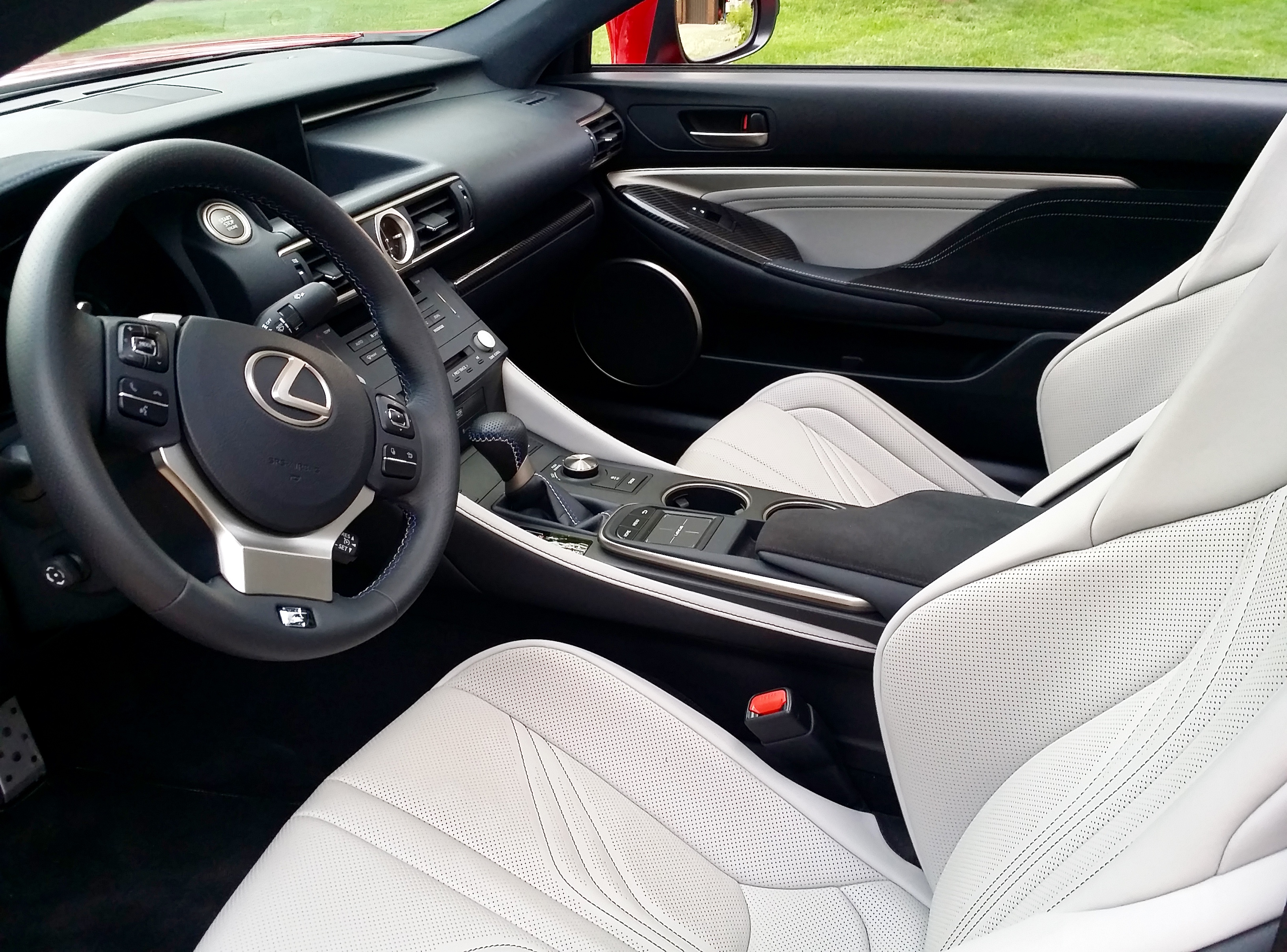
2015 Lexus RC-F RWD 2-Door Coupe

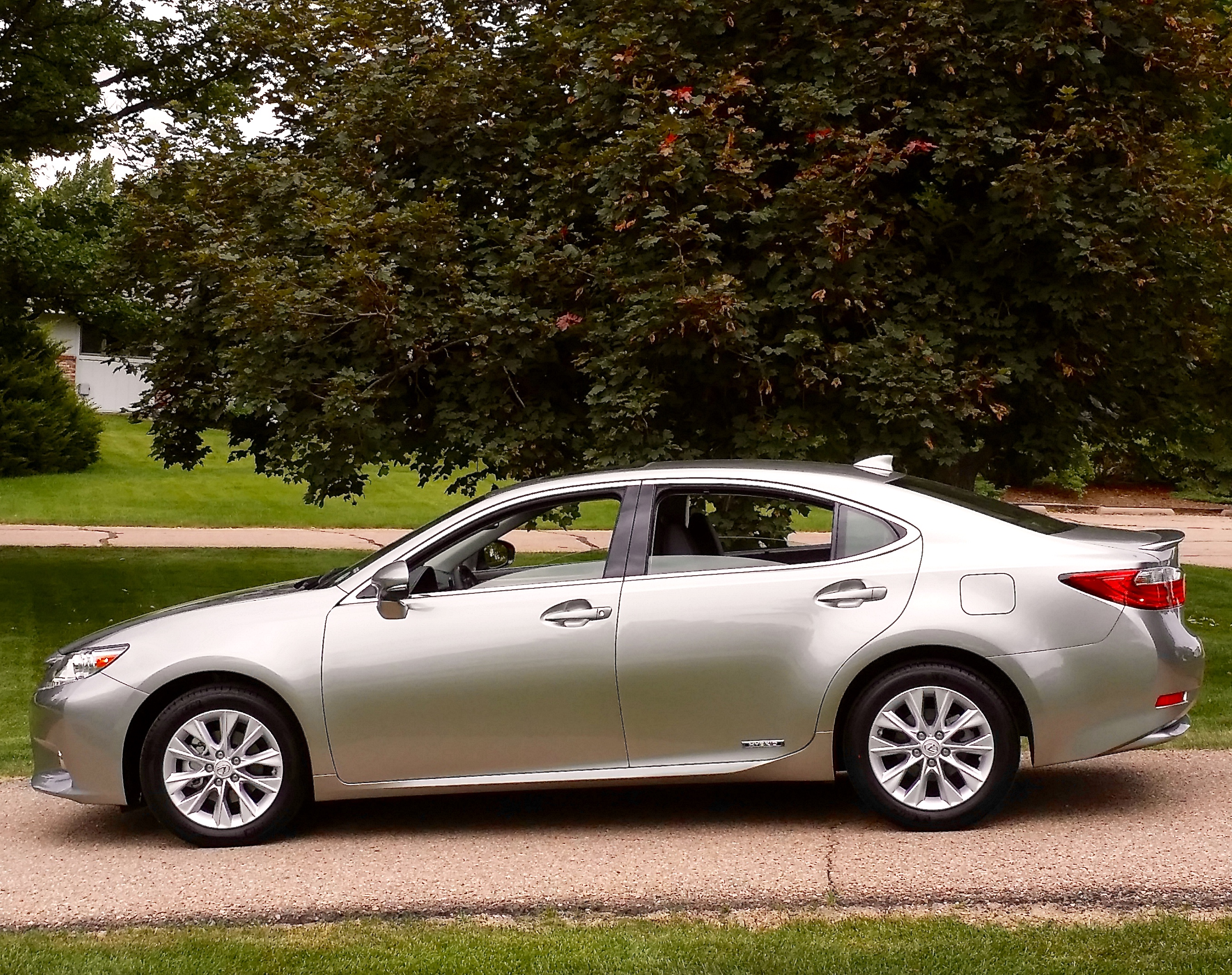
20150608_185153In late 2014, Lexus brought out their high-performance version of the RC Coupe, the RC-F, as a 2015 model offering.  The RC-300h and RC-350, the original V-6 coupes, were upgraded to a V-8 in this new car, a 5.0 liter, 90 degree, four-cam power plant.  The RC-F is essentially a blend of three prior Lexus models – GS and IS sedans and the IS-C convertible.  What the amalgamation resulted in was what I called a “supercar” all week long during my testing of the RC-F.

In a pleasant turn of events, on several occasions nearby motorists, upon blowing their horn, were seen giving me and Ruth a “thumbs up”, as opposed to the customary shaking fist.  They must have agreed with me as far as the “supercar” characterization goes, and admittedly the Infrared paint and terrific styling makes getting around in obscurity quite difficult.  Lexus likes to say “you’ll turn heads” with the RC-F, and indeed we did.

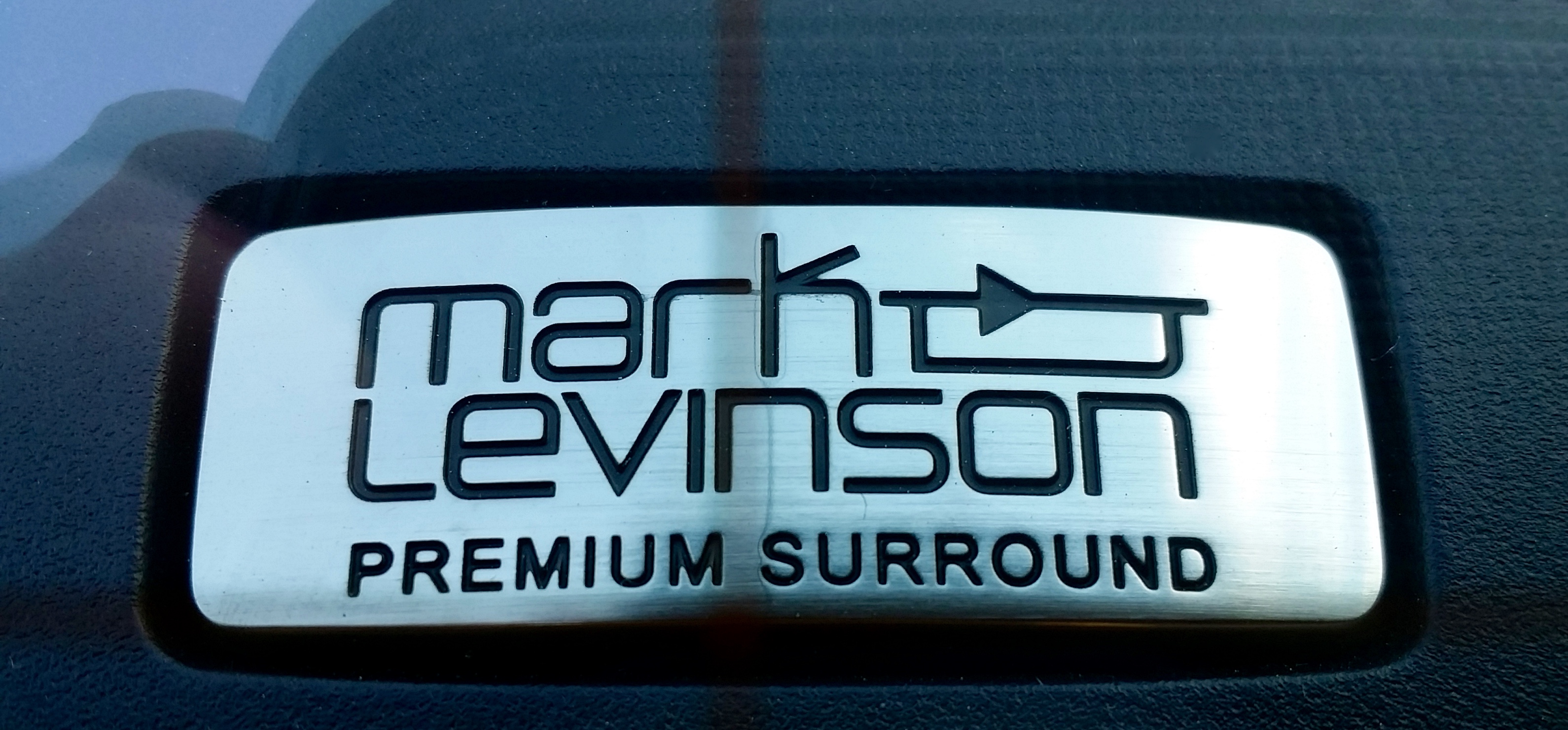
M.S.R.P. of my test Lexus came in at a total of $74,560.00, including freight.  The base price ($62,400.00) had as options the following: 19″ hand polished alloy wheels ($1,500.00), leather interior ($800.00), navigation package ($2,840.00), the paint ($595.00), premium package ($4,400.00), and moonroof ($1,100.00).  Thus the four passenger RC-F was equipped with pretty much every imaginable interior amenity including the Mark Levinson rock-crushing, 835-watt, 17-speaker surround sound audio system.

20150614_085919

The RC-F has a fairly smooth drag coefficient of .33, and reportedly has a top speed of 168 mph.  On the dashboard is situated a tennis-ball sized, 200 mpg speedometer and a rather large 9,000 rpm tachometer.  A rating of 467 horsepower from the throaty V-8 is at an impressive 7,100 rpm, and the torque rating is 389 lb. ft. at 4,800 rpm.   Four driving modes are available on the console-mounted knob of this car –  Sport S mode alters the powertrain for more dynamic throttle response, Sport S+ mode adds steering enhancements to help provide a higher level of responsiveness, normal mode provides the optimal balance of fuel efficiency and engine performance, and ECO mode moderates the throttle response, engine power output and climate settings for increased fuel efficiency.  My favorite was, of course, the Sport S+ mode, and even Ruth urged me to make the selection when we rode around together.  Part of the reason for our desire to drive in that mode was the active sound control that Lexus installs – at engine speeds up to 3,000 rpm, the system issues a steady tone of low and deep sounds.  And as the engine speed increases, the tone transforms into a higher-pitched note that blends with the engine’s mechanical sounds, and it really honks above 6,000 rpm.20150611_05594520150614_090048

The RC-F transmission is an eight-speed sport direct shift automatic that is smooth operating in normal and Eco modes, and more abrupt in the two sport modes.  Paddle shifters are on hand and the two-door coupe has rear wheel drive with a Torsen limited-slip differential.  Zero to sixty acceleration is reportedly 4.5 seconds. Wheelbase of the RC-F is 107.5″, overall length is 185.2″, the trunk holds 10.1 cubic feet of luggage, and the weight is 3,958 lbs.  It is the same size as Ford’s Mustang and about 200 lbs. heavier.20150614_090119

I averaged 20.3 miles per gallon with the Lexus, and provided it with its called-for premium gasoline.  The tank holds 17.4 gallons, and the EPA ratings are 16-city, 25-highway, and 19-combined miles per gallon.  Purchasers of the Lexus RC-F don’t care about the information in this paragraph, but do care about the rocket-ship performance and dynamite styling of it.  This reviewer could recommend a long look at the RC-F if that is the twin desires of their purchase.   20150611_060048


2015 Subaru BRZ Series.Blue RWD

SAM_4073Subaru and Toyota joined forces a few years ago to produce a rear-wheel drive sports car and in 2013 they introduced what Subaru named the BRZ.  Subaru provided the engine for the unit and even landed the job of producing the car for both companies.  The Subaru name (BRZ) denotes boxer engine (B), rear-wheel drive (R), and Zenith (Z), which means a point in time when something is most powerful and successful.  Toyota put out their sports car with a Scion nameplate and named it the FR-S.

I found a 2015 BRZ Series.Blue in my driveway last week courtesy of Rocky Mountain Redline, and the driver came to the door with the keys.  Actually, I didn’t need the keys in my hand when I left the neighborhood because the Subaru has “keyless access and start”, allowing you to enter and drive with the keys in your pocket.  This BRZ had the big red “STI” starter button because of its designation as a Series.Blue, a limited production model (limit, 1,000), with a lot of other special equipment on hand, as well.SAM_4065

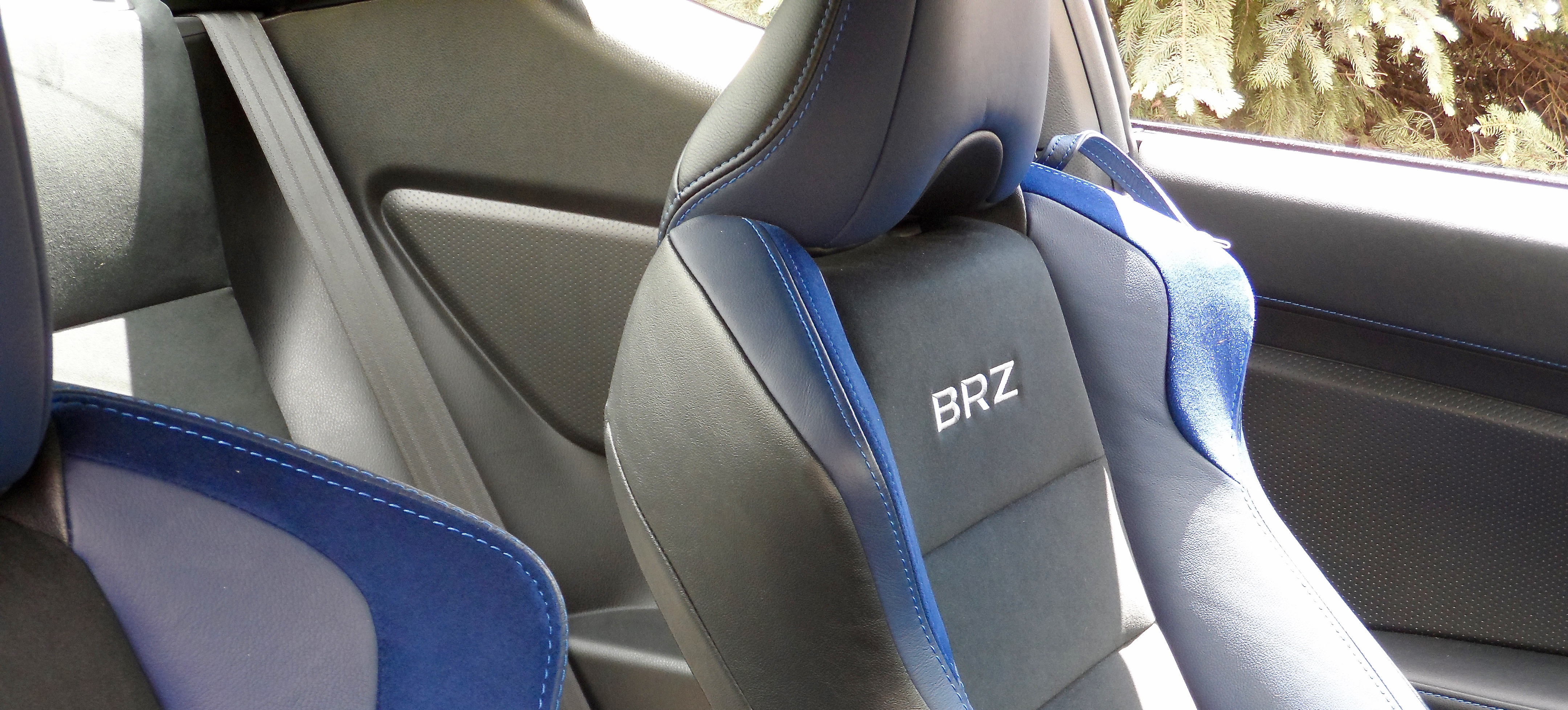
Subaru has built 500 of these WR Blue Pearl metallic BRZ’s (they are done), and 500 Crystal White Pearl ones.  All of them have as upgrades the following items:      black STI front, side, and side-rear under spoilers for keeping the BRZ well-grounded at high speeds, red-finish brake calipers that can be seen between the spokes of the wheels, special 15-spoke black painted STI wheels, and the special red illuminated engine start/stop button.  Also, the car sports leather and Alcantara upholstery featuring blue leather seat bolsters and head restraints. The unique color continues with Blue stitching accents on the seats and the blue and black leather-wrapped steering wheel, as well as the shift lever boot and leather-wrapped parking brake handle.

Interior appointments of the Subaru included audio/navigation system, cruise control, heated front seats and mirrors, power windows, Bluetooth phone connectivity, and AM/FM/XM/CD radio.  Ruth and I drove to Denver and back in the car and the seats did not annoy, the guidance on the highway was great, and road noise was suitable for such a car.SAM_4064

The BRZ, trimmed-out as nicely as it was, still shines brightest on the road.  It is powered by a 2.0 liter, four cylinder boxer aluminum engine that provides 200 horsepower (@ 7,000 rpm) and 151 lb.-ft. of torque (@ 6,400 rpm).  The punch-counterpunch action of the boxer pistons in the Subaru cancel each other out and provide a smooth delivery of power.  Also, the horizontally opposed engine results in a lower center of gravity in the vehicle (18”), aiding the handling and cornering characteristics.  Porsche and Subaru are pretty much it when it comes to boxer automobile engines, and the design is found in some BMW and Honda motorcycles.  The motor was patented by Germany’s Karl Benz in 1896.  Fuel economy ratings on the BRZ are 22-city, 30-highway, and 25-combined miles per gallon.  The car burns premium unleaded gasoline, and the tank holds 13.2 gallons.SAM_4078

My test BRZ had a six-speed manual transmission, and what a pleasure it was to operate with a snick-snick short-throw shifter/linkage setup.  A sport-tuned suspension is installed along with a Torsen limited-slip rear differential and 4-wheel disc (11.5″) brakes.  Reportedly, the 2,800 lb. BRZ travels from zero to 60 in SAM_40636.4 seconds.  The black wheels are 17″ in diameter and are fitted with P215/45R17 Michelin Primacy HP summer radials.

M.S.R.P. for the Subaru was based at $27,695.00.  Freight and the Series.Blue package ($1,795.00) brought the total to $30,285.00.  Shoppers looking for a 2 + 2 sports car for around $30,000 with terrific styling and performance would be well-advised to look at the 2015 Subaru BRZ Series.Blue, if they can find one.


2015 Dodge Charger SXT AWD Sedan

This slideshow requires JavaScript.

I see that AutoTrader advertisements are featuring a number of Dodge Chargers, specifically the “General Lee” of Dukes of Hazzard fame, and several white, late-model four-doors similar to my latest test car.  It was a 2015 Dodge Charger SXT all-wheel drive sedan and was painted Ivory tri-coat pearl.  Inside it was Tungsten (gray) cloth sport upholstery with the front bucket seats both powered and heated.

The General Lee was a 1969 Dodge Charger driven by the Duke cousins Bo and Luke, in the television series The Dukes of Hazard. The car is known for its special horn, its high speed chases, stunts, long jumps, and for having its doors welded shut, leaving the Dukes to climb in and out through the windows.  The car’s name is a reference to the Gen. Robert E. Lee and it bears a Confederate flag of America (representing the army which Robert E. Lee commanded) on its roof, and also has a horn that plays the first twelve notes of “Dixie”.  On average, one General Lee Charger was used up per television episode, and legend has it that between 250 and 32o automobiles were destroyed during filming of the series.  Stunt drivers were known to enjoy the long jumps, but they reportedly hated the landings.

Shortly after the “Dukes”, the Dodge Charger was nonexistent for nineteen years before its re-introduction in 2006.  That’s when it came out as a four-door, rear-wheel drive sedan with styling that was supposed to harken back to the 60’s and 70’s glory days.  All-wheel drive has been subsequently added as an option to the car, and my test Charger was equipped as such.  The SXT model I drove represented the model sixth down from the Charger SRT Hellcat, one of five V-8 hemi-powered machines, and it sits atop the four V-6 models that the company offers.

Base price of my Charger was $32,995.00, and as options it had the fancy paint ($500.00), and navigation/backup camera ($995.00), so with freight of $995.00 the total M.S.R.P was $35,485.00.  I thought it was pretty reasonable, and some omissions responsible for the decent list price included the solid roof and the cloth seating.  But it was a quite attractive automobile and handling, guidance, ride and road noise level are were satisfactory to this reviewer.

Equipment on the SXT included remote engine start, hill start assist, XM radio, 8.4″ touchscreen for audio and navigation, 276-watt stereo, and Chrysler Corporations proprietary UConnect infotainment system.  Interior space amounts to 104.7 cubic feet and trunk space is 16.5 cubic feet.  The two spaces can be blended together by virtue of the 60/40 split-folding rear seatbacks.

Power for the Charger that I drove comes in the form of a 3.6 liter Pentastar V-6 with 292 horsepower and 260 lb. ft. of torque.  A Rally group, not present on my test car, pushes horsepower to 300.  My 292-horsepower Dodge was rated at 18 mpg-city, 27 mpg-highway, and 21 mpg-combined (EPA).  Observance of mileage came in at a respectable 24.5 during a week with the car.  Attached to the Pentastar was a Torqueflite eight-speed automatic transmission with a sport mode.

The Charger was pretty sitting in the driveway, particularly up front (I backed it in the driveway at all times, driving the wife nuts), and the look is new for 2015.  Wheels were 19″ polished aluminum with graphite pockets and tires were P235/55R19 Michelin Pilot HXMXM4 mud and snow radials.  Dual chrome exhaust finishers were under the rear fascia.  It was a good ride and is to be recommended to the value- and style conscious full-sized sedan shopper.


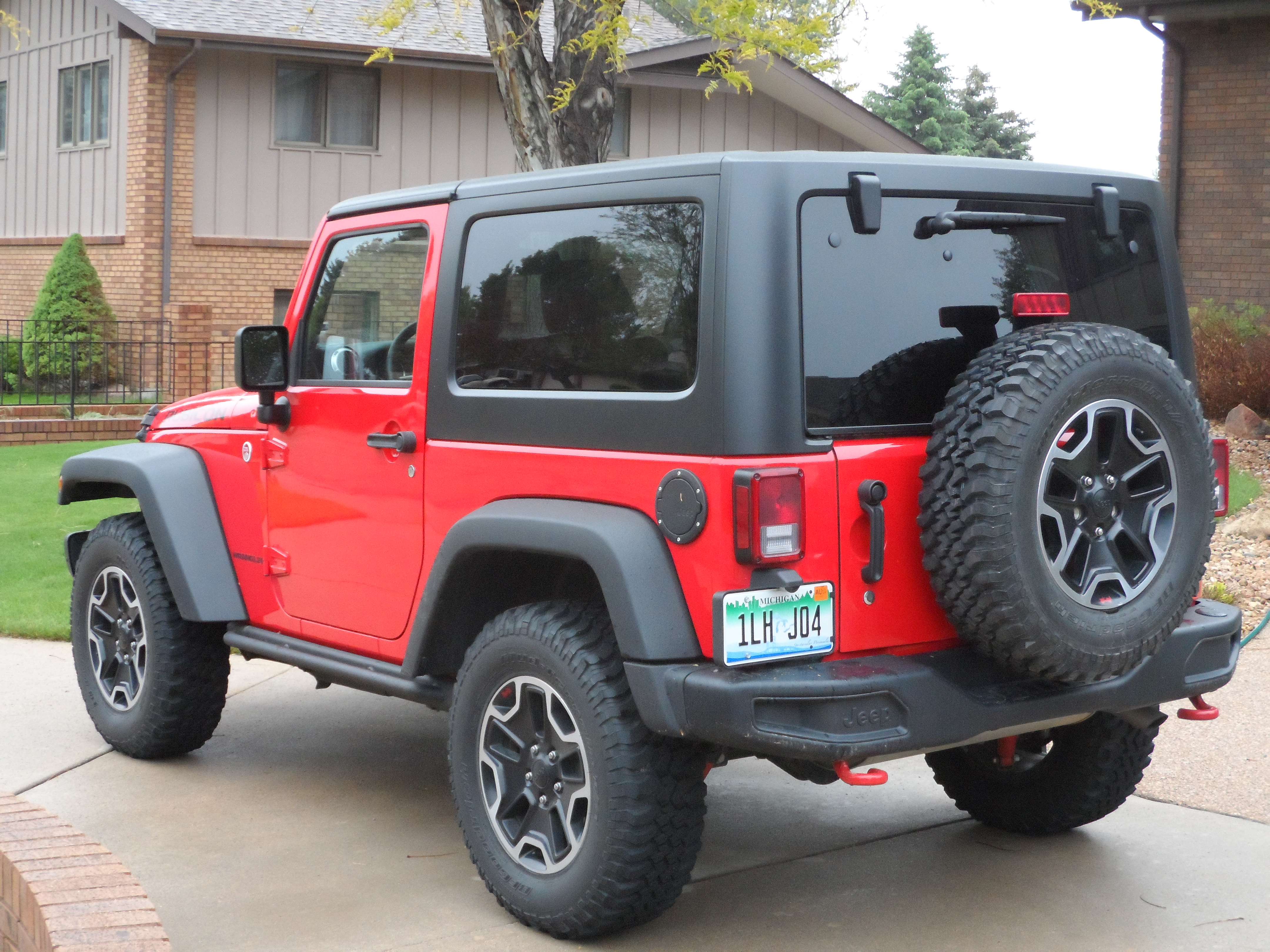
2015 Jeep Wrangler Rubicon Hard Rock 4 X 4

SAM_4028

Jeep has been building off-road and sport utility vehicles since 1941 (civilian vehicles since 1945), making it the country’s oldest SUV brand.  They were originally provided for the U. S. military during World War II, specifically light 4-wheel drives for the Army.  Willys-Overland, the manufacturer of Jeeps, provided about 640,000 units for the war effort, and the initial contract price was $648.00 each.

Thousands of Jeeps were left behind in the Philippines after the Allied victory over the Japanese, and most were converted to taxis and became the primary mode of public transportation there.  Called Jeepneys (Jeep/jitney), they were also my primary mode of transportation beyond the gate at Clark AFB while I served there in 1970.  Up front, each Jeepney had a driver and a conductor, who managed passengers and collected fares.  Air Force GI’s rode in them to their favorite bar for about 20 cents.  Jeepneys in the PhilippinesSAM_4031

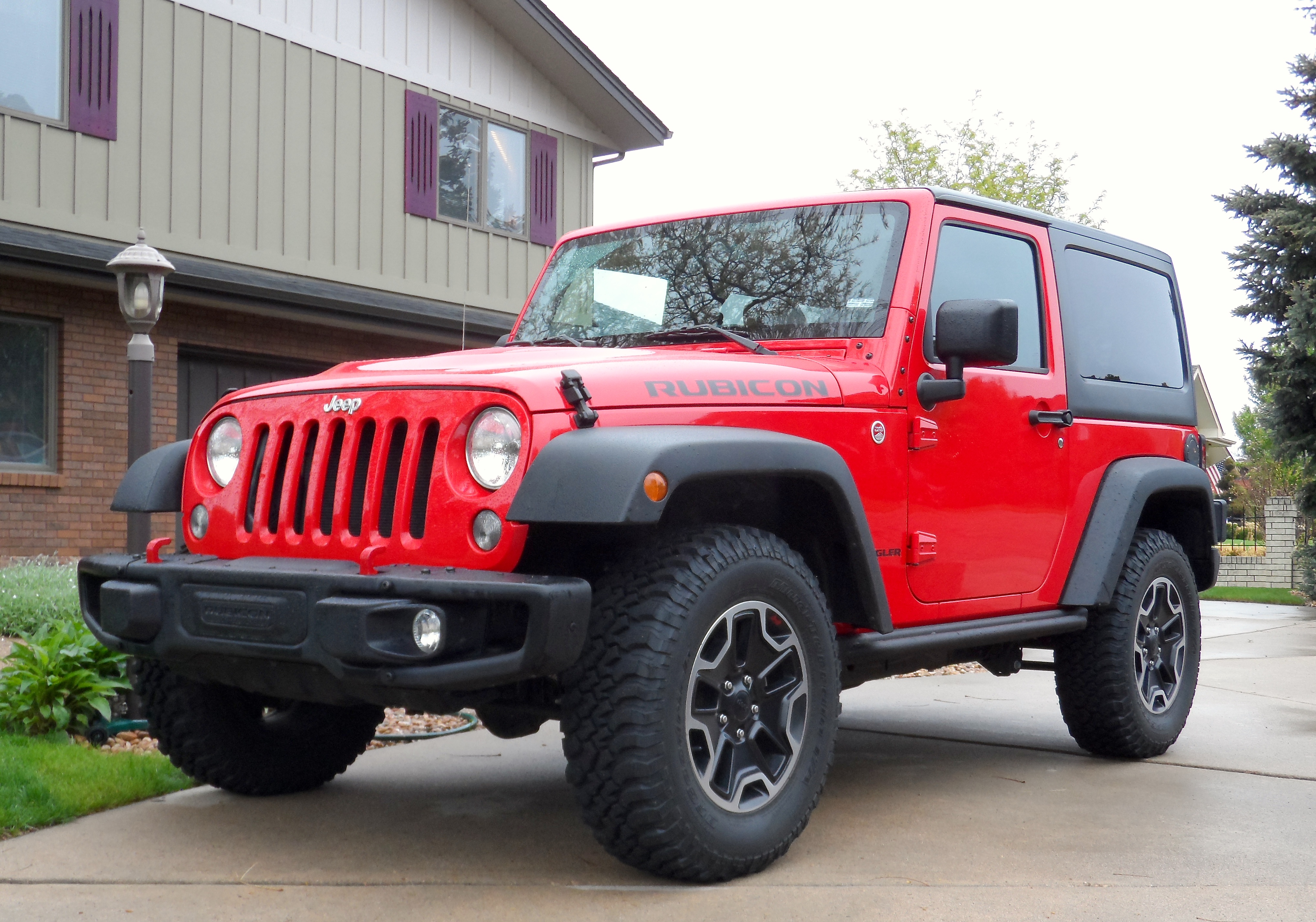
Jeep, now owned by Fiat Chrysler Automobiles, LLC, has sold the Wrangler since 1987, and the compact SUV is now in its 4th generation configuration.  Since 2007 it has been available in a 4-door “Unlimited” model with an additional 20.6” of wheelbase, but my latest test vehicle was the Wrangler Rubicon 4×4 Hard Rock two-door  Although much evolved, the Wrangler remains a knockoff of the original Army Jeep of the 1940’s.

My test Wrangler was good-looking Firecracker red clear coat paint outside with black leather seating and front buckets that were heated.  M.S.R.P. for the Jeep was $39,255.00 and included the base price, freight, connectivity group ($1,570.00), 3-piece hard top/soft top ($595.00), and Hard Rock convenience package ($4,500.00).  The Hard Rock package included power locks/windows, cruise, tilt, XM radio, fold-down 3 passenger rear seat, and Bluetooth connectivity.    Cargo capacity is 55 cubic feet with the back seat folded and 12.8 cubic feet with it erect.  SAM_4032

A nice feature of this year’s Wrangler is the new 3.6 liter Pentastar V-6 with 285 (@6,350 rpm) horsepower and 260 (@ 4,200 rpm) ft. lb. of torque.  Along with the 6-speed manual transmission, it provided me with enough power and can go zero to 60 in 8.5 seconds.  Gas mileage ratings are 17/21, city and highway, 18 combined and my observation was 18.8 mpg for the week.  Ride and guidance on the road with the Jeep is better than can be expected and wind noise is acceptable.  Off-road capability is exemplary, of course, with 2-speed transfer case, ample ground clearance, and the limited-slip differential.

I mentioned the paint – also, the Jeep had 17” polished semi-gloss black 5-hole alloy wheels, BF Goodrich Mud-Terrain T/A, LT255/75R17 black-letter tires, fog lights, iconic seven-slot grill, and front tow hooks on the bumper.

When the Rubicon arrived, I was extremely excited to run around with it.  Not being a hunter or fisherman, however, I suppose ownership of such a car would be inadvisable for me.  For those that want it for those activities, I strongly suggest they take a look at buying one of these Jeeps.

2015 KIA Sedona SXL FWD Minivan

SAM_4012This last week the Drive Shop dropped off the new Sedona from KIA, a minivan which in its third generation form was just introduced in the U. S. last year.  Actually the firm calls this car a multi-purpose vehicle in order to attract more buyers to the brand, and to the model.  My test loaner was the SX Limited model painted Deep Formal blue metallic and featured a burgundy and ash Nappa leather interior with four bucket seats.

KIA is headquartered in Seoul, South Korea, and is that country’s second-largest automobile manufacturer, trailing only Hyundai Motors, a one-third owner of KIA Motors Corporation.  KIA is also the oldest auto manufacturer in Korea, founded on June 9th, 1944, as a maker of bicycle parts and metal tubing.  The word KIA is roughly translated as “rising out of Asia”, and the company sold 2,907,757 vehicles worldwide in 2014.  That represented a 5.9% increase over sales from the year 2013.SAM_4026

In the styling department, there isn’t much that a manufacturer can do to set their offering apart from the pack, so I think KIA did the best they could do on this Sedona SXL.  They put ample chrome on the car (including on the door handles and the ten spoke alloy wheels), but the front end look is where exemplary work was done with the grill and lighting treatment.  At the New York Auto Show last year where the Sedona was introduced, the car was named Best New Car Design.

Ruth and I drove the Sedona to Nebraska for our test to visit relatives.  That put us out on Interstate 80 weaving around big rigs that seem to multiply on the weekend.  I surely enjoyed the Smart cruise control for the endeavor, which allowed me to keep my feet flat on the floor while darting from lane to lane with appurtenant speed discrepancies.  Other technology/safety items included on the KIA were blind spot detection/lane change assist, lane departure warning, rear camera display, forward collision warning, surround view monitor, and rear park assist.  Most of these items were included in the SXL technology package for an additional $2,700.00.  That, plus a base price of $39,700.00 and freight of $895.00, brought the total M.S.R.P. to $43,295.00.  This price is right in middle of pricing I have seen on the competitive minivans (excuse me, multi-purpose vehicle), and this was, after all, KIA’s top of the line model.

The two-toned leather buckets (4) were attractive and kept me in a comfortable attitude for my trip and the week here in Greeley.  Relatives enjoyed the second-row buckets with armrests (and footrests), and I suppose everyone was happy to jump on board and ride in the third row, although I didn’t hear much from them.  They were riding on a 60/40 split fold-in-the-floor bench, and luggage space behind it amounted to 62.1 cubic feet, with a deep well to enhance that number.  Outside, the KIA is 201.4″ long, 78.1″ wide, 68.5″ high, weighs 4,720 lbs., and can turn around in a 36.8′ circle.

Minivan power for the KIA comes in the form of a 3.3 liter, V-6 with 276 horsepower (@ 6,000 rpm) and 248 lb. ft. of torque (@ 5,200 rpm).  A six-speed Sportmatic overdrive transmission is employed and EPA fuel economy ratings are 22-highway, 17-city, and 19-combined miles per gallon.  My average for a windy drive of 650 miles was 19.9 mpg.  I thought the ride was fine, as was guidance and handling in the city.  Overall, I would rate the Sedona (a good name) right in line with its minivan competition with perhaps a little edge because it is so good-looking.

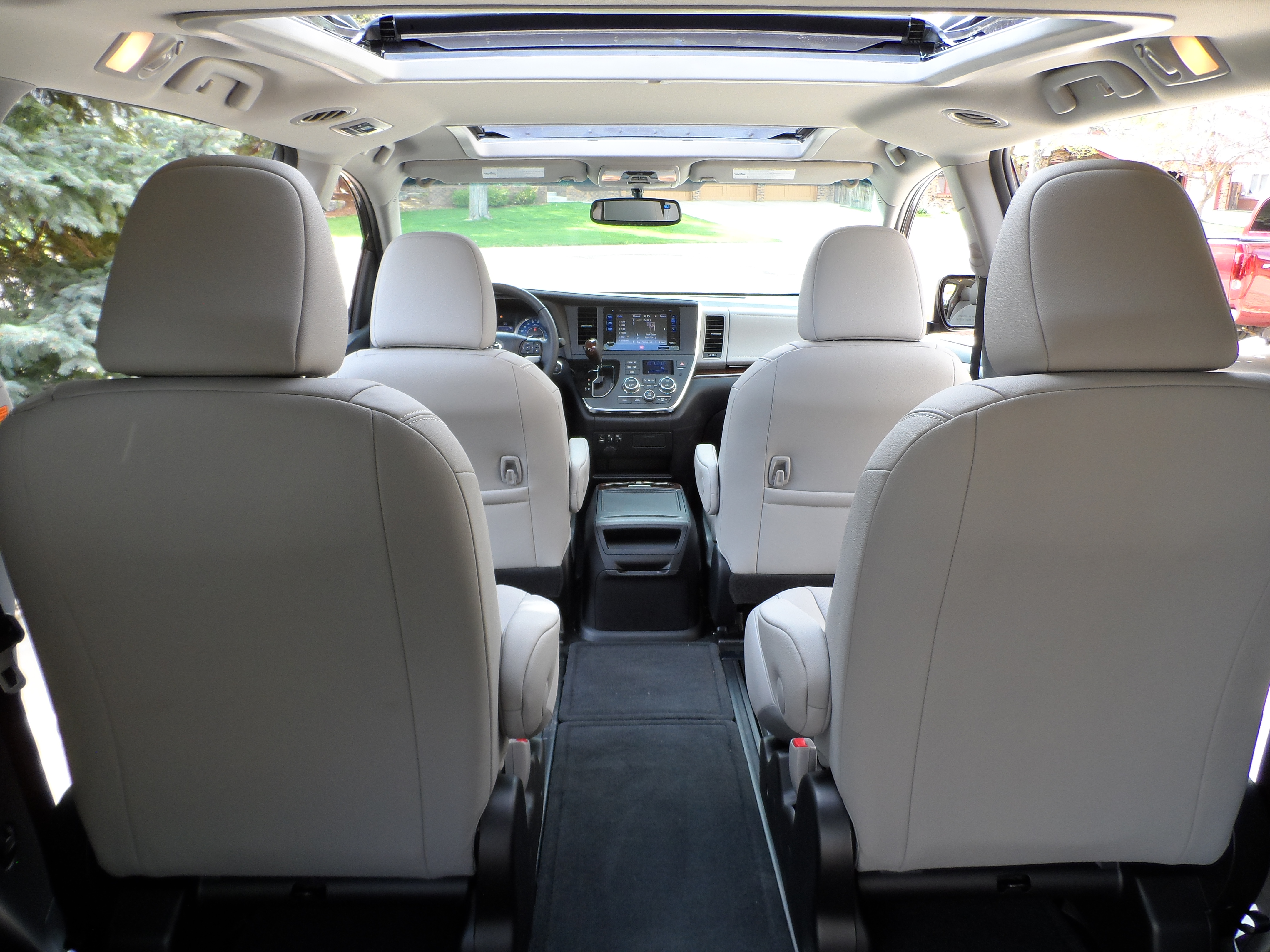
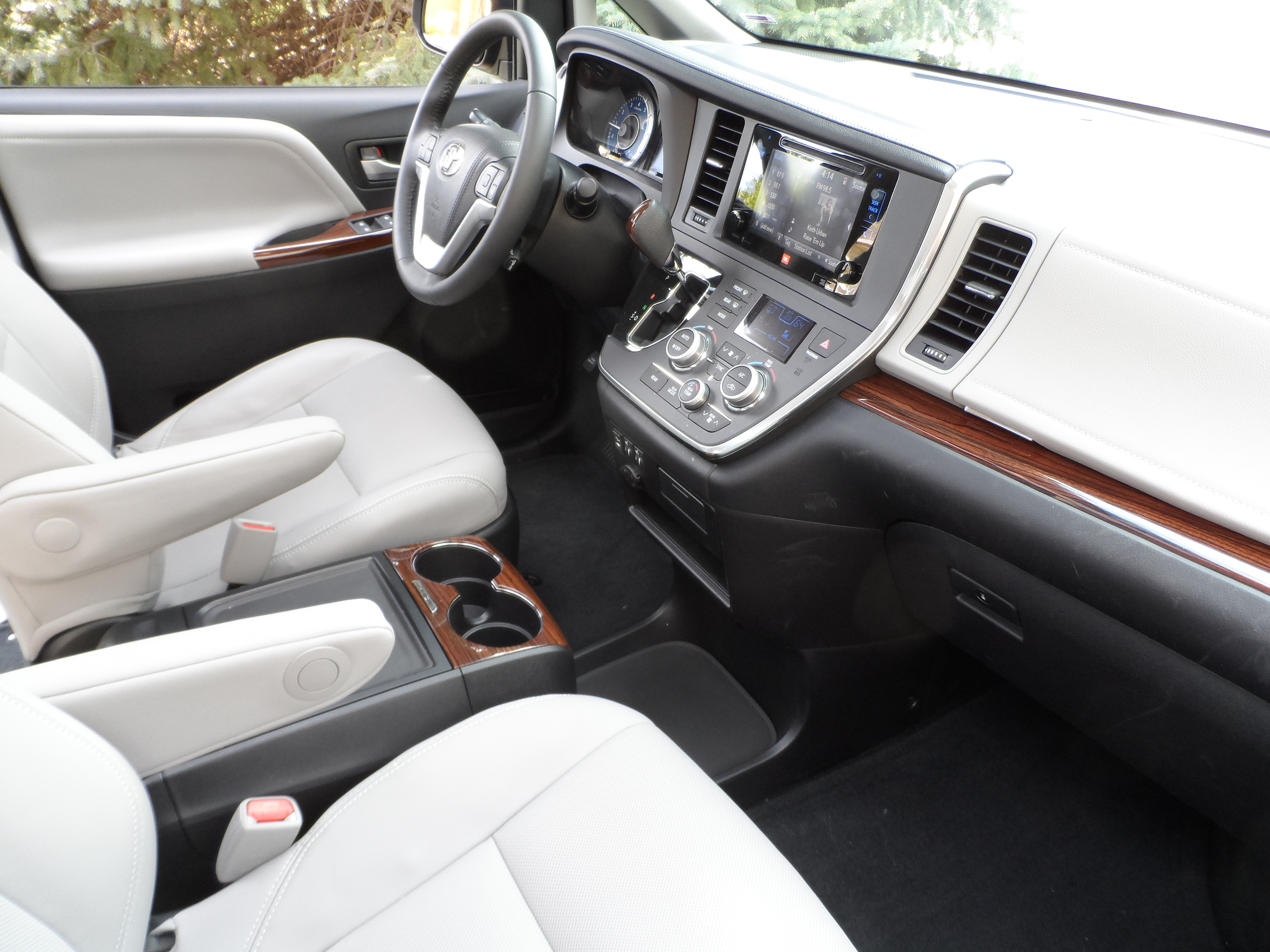
2015 Toyota Sienna Limited 3.5L AWD 7-Passenger Minivan

SAM_3984For the second time this year, I received from the Rocky Mountain Redline press fleet a Toyota Sienna minivan to test.  It was an all-wheel drive model, unlike the earlier front-wheel drive tester.  It also arrived at a more pleasant time of year, as the red model was here during a particularly frigid spell in January.  As you can see from the photo, my 2015 test van was around here for some very nice spring weather.

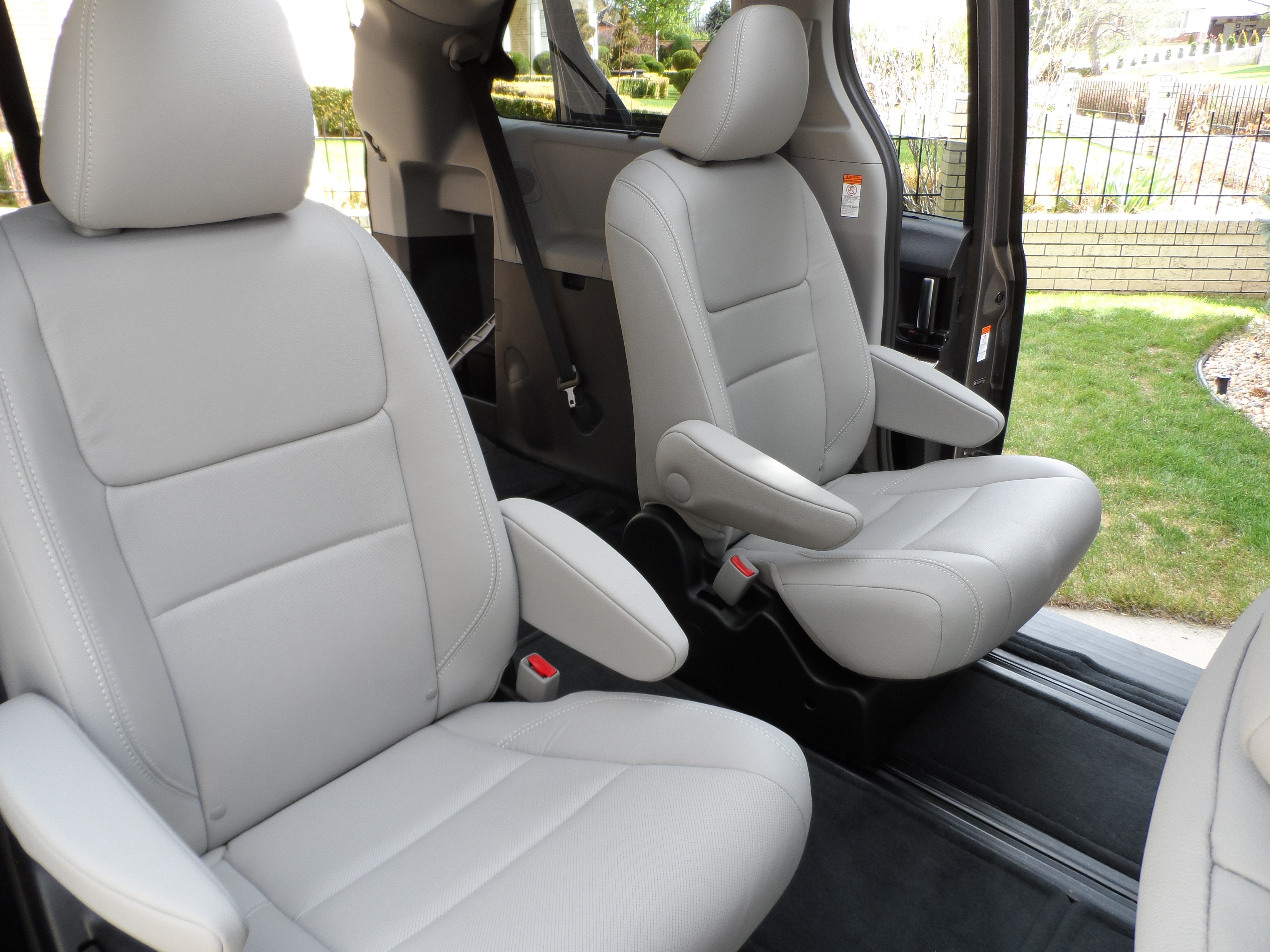
My Sienna was the Limited 3.5L model with several upgrades such as backup camera, audio/navigation with 7″ screen, SiriusXM radio, Bluetooth connectivity, Toyota’s Entune Audio Plus app suite, ash-tone leather seating for seven, 2nd-row lounge-seat captains chairs, stowable third row seat, cruise control, tilt/telescope, Smart Key system with pushbutton starter, triple 12v power outlets, blind spot monitor, parking assist sonar, rear cross traffic alert, and ten cup holders.SAM_3989

Toyota’s Sienna Limited comes in five different colors and the one I drove was painted Predawn Gray Mica metallic.  Of course the vehicle was equipped with power sliding side doors (they have roll-down windows), dual moon roof openings, and a power rear lift gate.  The length of the Sienna was 200.2″ set on a 119.3″ wheelbase; weight was 4,705 lbs.  Getting in and out of the minivan is easier than a sedan and not quite at a crossover SUV level of convenience.  Visibility is great, as is ride and guidance on the SAM_3987road.  Handling is excellent for a minivan.

Minivan styling is not an attraction to such a vehicle, although I personally like the looks of all of them.  This Sienna had attractive ten-spoke machine-finished 18″ alloy wheels with P235/55R18 Bridgestone Turanza EL400 steel-belted all-season radials.  Luggage rail cross bars were up top, chrome door handles were installed, and round fog- and backup-lights dressed up the fascia, front and rear.

SAM_3988Power for the all-wheel drive Toyota minivan is produced by a 3.5 liter V-6 with 266 horsepower (@ 6,200 rpm) and 245 lb. ft. of torque (@ 4,700 rpm).  A six-speed automatic is coupled to it with the shift tower mounted on the dashboard to the right of the steering wheel.  Thus, the driver (or front passenger) can slide over to the other armrest-equipped bucket seat, if desired.  Fuel economy for the Sienna is 16 mpg in the city and 23 mpg on the highway.  The combined rating is 19 mpg.  I found the performance of my test Toyota to be suitable, and the company also offers an front-wheel drive setup on the Sienna, which is what I drove early this year.

M.S.R.P. for the van carried a base price of $42,780.00; freight ($885.00) , roof rack cross bars ($185.00), remote engine start ($499.00), and four-season floormat package ($475.00) brought the total to $44,824.00.  I enjoyed testing the Sienna and it seems to me to represent a good value in its segment.

2015 Hyundai Santa Fe Sport 2.0T AWD

SAM_0616Hyundai Motor Group is one of the five biggest automobile manufacturers in the world, and part of the firm is KIA, a popular line of automobiles.  Hyundai is the main nameplate, and one which was on the Santa Fe Sport 2.0T crossover that I recently tested.  It was loaned to me courtesy of STI-Drive in Denver.  The Santa Fe is, as you might expect, named after the beautiful New Mexico city 450 miles south of my home of Greeley, Colorado.

The Santa Fe is based on the Hyundai Sonata sedan platform, and is classified as a mid-size crossover.  It is currently in its third generation form, and has been produced since 2000.  The one I tested was painted Canyon Copper metallic and inside it was upholstered in perforated beige leather seating for five.  Its M.S.R.P. totaled $38,350.00, and that included $875.00 for freight and $4,350.00 for the properly-named “ultimate” package.  Included in that last package were HID headlamps, LED taillights, panoramic moon roof, navigation system with 8″ touchscreen, 12-speaker Infinity stereo, heated seating front and rear, air conditioned front buckets, heated steering wheel and rear parking assist sensors.  Standard features of the Sport 2.0T included rear window sunshades, XM radio/CD disc player, power locks/windows/mirrors, pushbutton starter, blind spot monitor and power rear lift gate.SAM_0626

Power for the Santa Fe comes from a 2 liter, 4 cylinder turbocharged engine with 264 horsepower coupled with a 6-speed Shiftronic automatic transmission.  Acceleration was brisk, and is reportedly zero to 60 in 6.6 seconds.  EPA fuel economy ratings for the Sport come in at 18-city, 24-highway, 21-combined miles per gallon.  The tank holds 18.8 gallons, and that is a benefit.  SAM_3909

A compliant ride provided comfort for my wife and I when we travelled to Cheyenne to conduct some business.  The car SAM_3900handled wind (it had to up there) well, and wind noise inside is acceptable.  For about town driving and a little off road usage, both hillstart assist control and downhill brake control are on hand to make things a little more manageable.

The attractive interior had two rows of seating (front buckets), and there is 35.4 cubic feet of cargo space behind the second row.  If that row is folded down, the numbers moves up to 71.5 cubic feet.  The second row seat is a 40/20/40 folding affair.  The heated and air conditioned front buckets were supportive and comfortable (and attractive).  The all-wheel drive car is 193.1″ long, rests on a 110.2″ wheelbase, and has 146 cubic feet of passenger volume inside.

SAM_3895Styling, a hallmark of the Santa Fe, picked up some glances (and stares) during the week driving the Santa Fe, and I particularly liked the color.  Chrome handles were on the doors, Ten-spoke 19″ alloys were mounted on the axles, and the tires were P225/55R19 Continental CrossContact LX sport all season radials.  The Hyundai was a pleasure to test, and in my mind it represents a good value with its sub-$40,000.00 window sticker.

2015 Jeep Patriot Latitude 4WD

SAM_0614Jeep has produced its Patriot since the introduction of the compact crossover SUV nine years ago this spring at the New York Auto Show.  It, along with the Jeep Compass, is manufactured on what is called the MK platform.  The Compass is designed to appeal to female motorists with the Patriot as a designated favorite of males.  The Patriot, in its Latitude model offering, is the subject of this week’s review, one which was loaned to me by Rocky Mountain Redline in Dacono, CO.

My Patriot test car (crossover?) was painted Granite Crystal metallic with Light Pebble beige leather interior.  The Latitude is stationed at the middle of the Patriot lineup, with a Limited model available for additional cost.  The Latitude carries a base price of $24,395.00, and freight adds $995.00 to that figure.  My Patriot had as options a preferred package (moon roof, power leather seating, etc.) for $1,095.00, a security package (security system, tonneau cover, etc.) for 695.00, a navigation package for $1,385.00, and a U-Connect/XM radio/Bluetooth technology package for $495.00.  Total M.S.R.P., therefore, was $29,060.00.SAM_3891

Styling of the Latitude has been around for nearly a decade, but has aged well and looks good.  “Patriot” and “High Altitude” badging on the car as well as the functional luggage rack gave it a “Jeep” look, as did the giant round headlamps.  Firestone P215/60R 17 Touring mud and snow tires were mounted on five-spoke gunmetal gray alloy wheels.

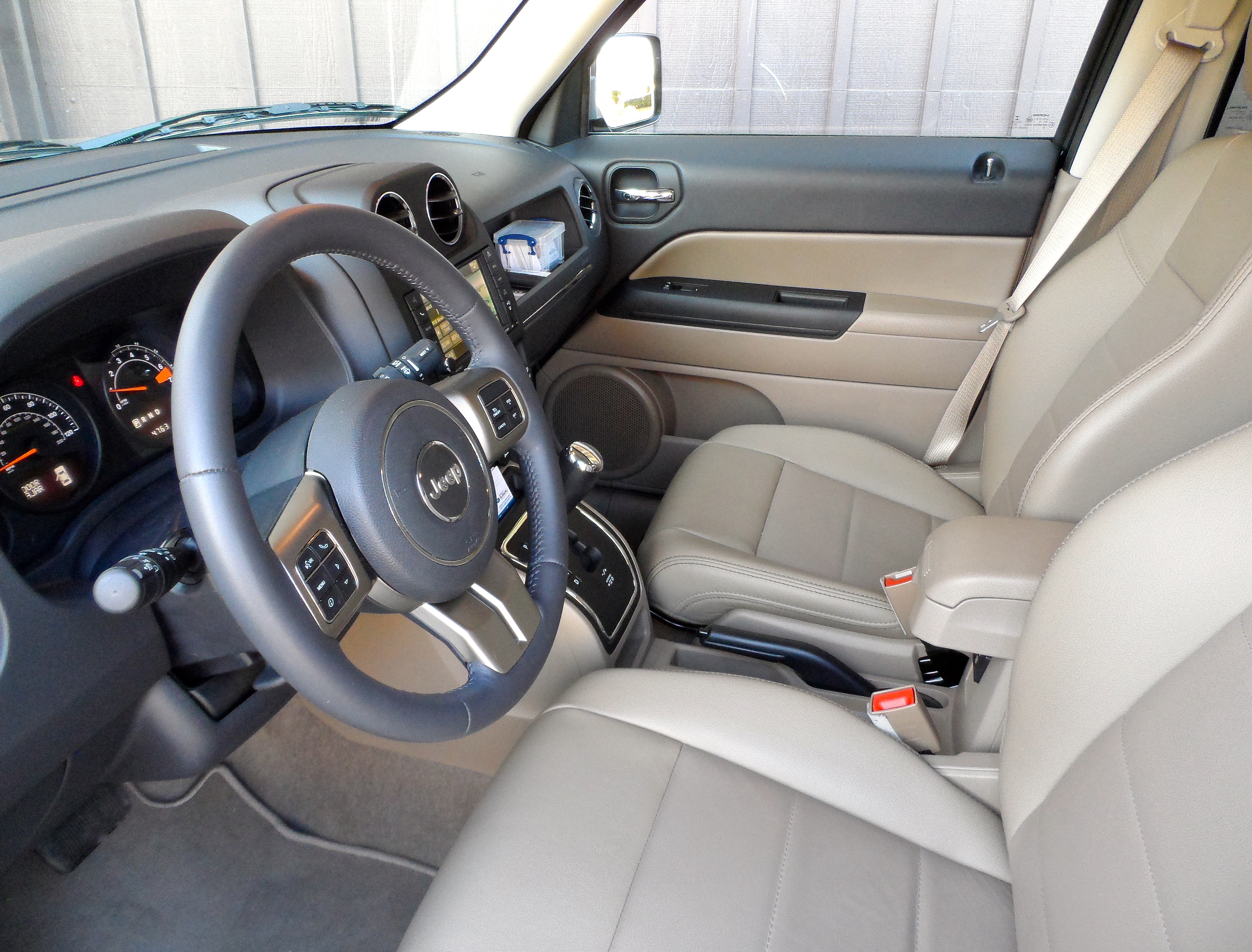
Inside, comfortable leather buckets and a bench back seat provide five passenger seating, and a tonneau cover can conceal guns or golf clubs in the 23 cubic foot luggage compartment (which expands to 53.5 when the second-row seating is folded flat).  Features included Bluetooth, air conditioning, power windows, liftgate speakers, keyless entry, remote start, a touch-screen audio system, the navigation, Uconnect Web with a Wi-Fi hot spot, satellite radio and a USB port.  A lever-type hand brake is on hand, and the shift tower is mounted neither on the console, nor on the dashboard; kind of in-between, like a Prius.  It worked fine with its duties to shift the six-speed automatic transmission, and an additional benefit of the interior is the space for odds and ends above the glove box in front of the passenger seat.  I liked it for my stuff while making rounds in the Patriot for a week.  A Jeep is the one brand of vehicle that I can name when entering blindfolded – that being a result of the husky, bold steering wheel grip.

The Latitude engine was a 2.4 liter, four cylinder with 172 horsepower (@ 6,000 rpm) and 165 lb. ft. of torque (@ 4,400 rpm).  EPA fuel economy is rated at 21 city-mpg, 27 highway-mpg, and 23 combined-mpg.  My observance was of 23.8 mpg for the week of driving the Latitude.  The fuel tank holds 13.5 gallons of regular unleaded gasoline.

Ruth, my wife, made mention of the visibility of the Patriot, which was good.  Driving the Jeep is pleasurable, with ride, guidance, and interior noise within tolerances.  It’s not a hot rod, but with 9.1″ of ground clearance and four-wheel drive, highway driving is not its forte.  All around utility is, and in that department I think the Jeep gets the job done, and for under $30,000.00, no less.

2015 Toyota Highlander Limited AWD Crossover

SAM_3838Toyota, the first company in the world to build ten million vehicles, came out with the Camry-based Highlander in 2001, having announced its anticipated arrival at the New York Auto Show in April of 2000.  It has been a sales success, racking up in excess of 1.5 million units sold to date.

For 2015, Toyota’s Highlander carries forward its renewed styling that was rolled out in 2014, and  is currently in its third generation iteration.  It is a car-based mid-sized SUV with seven-passenger, three row seating.  Sales of the Highlander (146,127 in 2014 – a record) places its revenue right in the middle of the Toyota SUV lineup.  The Toyota RAV-4 is the only model that produces more sales for the company than the Highlander.SAM_3842

This past week I was able to test a Highlander, a Limited top-of-the-line unit that carried an M.S.R.P. of $47,812.00, including freight.  The Limited’s base price was $41,300.00, and had as options a BluRay rear entertainment system ($1,810.00), driver technology package ($1,400.00), tow hitch/wiring harness ($699.00), side running boards ($599.00), remote engine start ($499.00), floor/cargo mat package ($225.00), and paint protection film on the front end ($395.00).  The Limited Highlander included a safety technology package, a moonroof, and perforated leather second-row captain’s chairs.  The extra technology equipment included radar adaptive cruise control, automatic high beam headlamps, blind spot monitor, lane departure alert, and pre-collision warning.

This slideshow requires JavaScript.

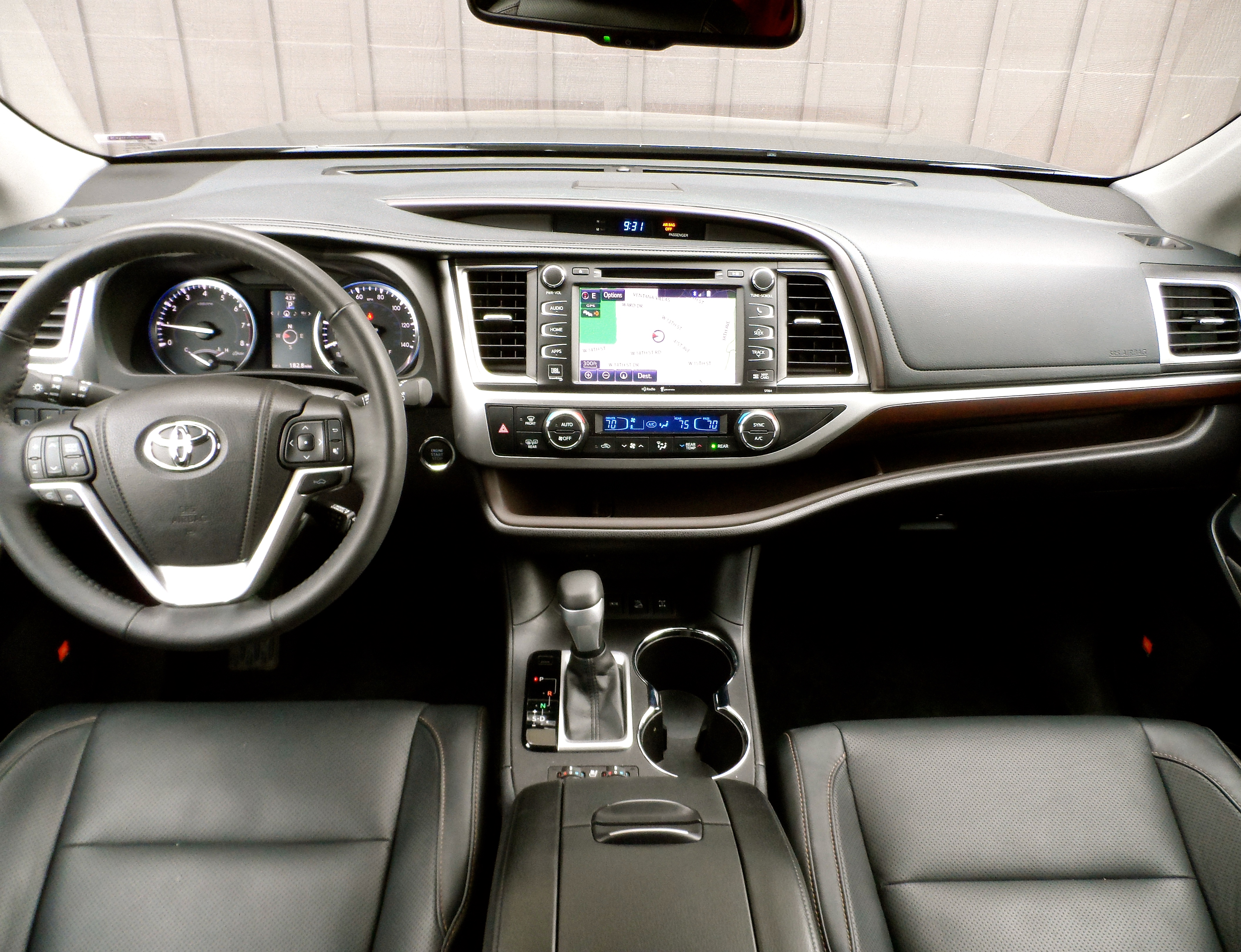
Additional Limited model items on my test car included power liftgate with glass hatch, 19” five-spoke alloy wheels, anodized roof rails, three zone climate control, JBL/Entune/navigation with 8” screen (the rear screen was 9″), perforated black leather seats, pushbutton starter, proximity keyless entry, tilt/telescope, heated and air conditioned front bucket seats, backup camera, and nice Optitron instrumentation.

Styling, with the 2014/2015 revision, was great.  So was the opulent-looking Predawn Mica gray paint, “Limited” badging, and polished Chromtec finish on the wheels.  The tires mounted on the alloys were 245/55R19 Bridgestone Dueler H/L 422  mud and snow radials.  The running boards on my tester added in both the utility and the styling departments.

Power for the Highlander is supplied by a 3.5 liter V-6 with 270 horsepower and 248 lb. ft. of torque.  The transmission is a six-speed automatic with snow mode and full-time four-wheel drive.  A unitized body is employed and four-wheel independent suspension and disc brakes are, as well.  EPA fuel economy ratings are 18-city and 24-highway, with a combined rating of 20.  For the week that I drove the Toyota, my observation was of 24.1 mpg.  Weight is 4,508 lbs., towing capacity is 6,000 lbs. and the fuel tank holds 19.2 gallons.  Overall length is 191.1”, 3” longer than the second generation Highlander, and cargo volume behind the third-row seat is 13.8 cubic feet.  With it folded down, that number increases to 42.3, and with the second- and third-row seats folded flat, total cargo capacity is 83.7 cubic feet.

I enjoyed the styling, interior comfort, visibility, road noise (lack of), and guidance of the Highlander.  The ride was satisfactory, and I feel that this year’s Highlander makes a nice family hauler and/or travel vehicle.  The U.S. public agrees with me, and great sales numbers are the result for Toyota.

2015 Toyota Avalon Hybrid Limited Sedan


SAM_0579
The 2015 Toyota Avalon, currently available in hybrid and non-hybrid configurations, is now in its fourth-generation iteration.  I recently was loaned one of them by Rocky Mountain Redline, and the car delivered was painted Celestial Silver metallic and featured premium black leather seating.  With all Avalon production taking place in Georgetown, Kentucky, the first unit rolled off of that assembly line eleven years ago as a 1995 model.  They are full-size, front-wheel drive sedans and represent Toyota’s biggest such offering.

At my age (the Beatles hit U. S. shores while I was in high school), the Avalon represented a nice car to be seen in, and drive around in, for the period of my evaluation.  The ride on its 111″ wheelbase is superb do to the MacPherson strut front suspension with offset coil springs and stabilizer bar and dual-link independent MacPherson strut rear suspension with offset coil springs and another stabilizer bar.  The room inside is ample for big, American motorists with 0ver 42″ of legroom is up front and over 39″ in the back seat area.  The same holds true for shoulder room in the car at nearly five feet of it, front and rear.  Overall length is 195.3″, six inches shorter than a Chevrolet Impala and 4.8″ longer than a Mazda 6.  The Avalon weighs 3,638 lbs., the same as the Chevy despite the fact it has a big hybrid battery on board.

The efficient power supply for the Avalon consisted of a 2.5 liter, 4 cylinder hybrid gas/electric engine with 200 hybrid system net horsepower (149 kW) and an electronically-controlled continuously variable (CVT) transmission.  The EPA estimates for the Avalon is 40 mpg – combined and city.  Highway mileage rating is 39 mpg – my experience for the week driving the car was 38.9 mpg.  The fuel tank holds 17 gallons of regular unleaded gasoline.  SAM_3763It’s impossible for the Avalon styling to offend anyone, young or old.  There exists up front the Toyota-specific big chrome mustache grill with black background, high intensity discharge (HID) quadrabeam headlights with auto on/off feature, and LED daytime running lights (DRL) with on/off feature.  The fifteen-spoke painted aluminum alloy wheels are fitted with P215/55R17 Bridgestone Turanza EL400 mud and snow radials.  No tailpipes are visible at the rear of the car (hybrid-style), but ample chrome is and a spoiler is almost molded into the trunk lid where underneath there is 14 cubic feet of cargo space available to the five passengers.

As you might expect, the inside the Avalon Hybrid Limited is sumptuous with its premium perforated leather-trimmed multi-stage heated and ventilated front seats, 10-way power-adjustable driver’s seat with power lumbar support and power cushion extension, and 8-way power-adjustable front passenger seat.  On hand are premium JBL stereo, navigation system, 7″ touchscreen, Bluetooth connectivity, power rear window sunshade, ten airbags, tilt/telescope, pushbutton starter, backup camera, smoked chrome accents, and power mirrors/windows/locks.

M.S.R.P. of the Avalon tester came in at $44,475.00, including $825.00 for freight and $1,950.00 for the technology package which included radar cruise control, automatic high beam, pre-collision safety system, and wireless charging platform for smartphones.  It’s a considerable investment, but a sound one given the comfort, beauty, and economy that the buyer gets in the bargain.