2012 Infiniti FX35 Limited Edition AWD

FX35 & Corn

This past week in Illinois I was presented an Infiniti FX35 to drive around the state.  Ruth and I picked it up at Chicago’s O’Hare International Airport and set sail to the Northwest towards Rockford.  Our ultimate destination was Galena, Illinois, an old lead mining town that is currently a resort, named a top ten “charming small town” by TripAdvisor for 2011.  The 1989 movie, “Field of Dreams” was partially filmed in Galena, and it was home to Ulysses S. Grant after the Civil War.

The Infiniti was Iridium Blue and had Graphite leather seating.  The Limited Edition FX35 is the top-of-the-line model that includes hard drive navigation, voice recognition information systems, “eye in the sky” parking assist, Bluetooth wireless, reverse tilt-down outside mirrors, 21” dark finish alloy wheels with ten spokes, adaptive front lighting (auto-leveling), dark aluminum roof rails, and aluminum pedals.  The CD/stereo/satellite/USB system was made by Bose with 11 speakers and speed-sensitive volume  control.  The blue paint was specific to this model and floor mats even had blue piping around the edges.  Of course, a moon roof and rear camera were on hand – the interior was stunning.

Infiniti has been producing the FX series of vehicles since 2003, and is the luxury division of Nissan Motors of Japan.  Styling has always been a hallmark of the vehicle and power is supplied in V-6 and V-8 configuration.  My FX35 had a 303 horsepower, 3.5 liter aluminum V-6 with 262 lb.-ft. of torque and 32 valves.  I drove a V-8 in Phoenix over the winter, and both it and this Iridium blue vehicle had plenty of snap.  The transmission is a seven-speed automatic with manual shifting and snow mode.  Zero to 60 mph time for the FX35 I drove was 6.4 seconds, and with a V-8 that number is reduced to 5.8.  Fuel economy ratings of the car are 16 city/21 highway (23.8 gal. tank), but during my week at the wheel the overall average was 22.3 mpg.  The FX35 weighed 4,299 lbs., wheelbase was 113.6”, and overall length was 191.3”.

Ruth and I enjoyed the ride across the state in the FX, but I wouldn’t want it to be any firmer.  This vehicle is somewhat of a sports car/crossover, with persons that ride in it at a low-to-the-ground attitude, despite the underneath clearance of 7”.  It is not an “off-road” four-wheeler, but a weather-fighter, nonetheless.  Cargo capacity behind the five-passenger seating is 24.8 cubic feet.

As mentioned, styling is the thing with an FX, and tourists all over the state were gathering at the rest stops to take a closer look at our ride.  Twin exhaust finishers peek out from under the rear fascia, and those fender vents behind the front wheel wells are functional.  The wheel wells that reveal the 265/45R21 V-rated all-weather radials, by the way.  The dark gray alloys seemed to be a big draw for the onlookers.

The M.S.R.P. for the FX35 was $52,445.00, including the freight charge.  That was about $14,000.00 less than the big V-8 we tested in Phoenix, and made this six cylinder buggy a pretty fair deal in my mind, and perhaps in those of the buying public.

“Evolution Orange” 2012 Toyota Prius C

Prius C

    An evolution is taking place within the Toyota Prius lineup, most recently with the introduction of their Prius c (city), which occurred earlier this year.  It’s the smallest Prius, and is the fourth model that the company currently makes available.  Toyota brought me an orange one to test last week, or at least that is what it looked like.  The color is Habanero, named after a chili pepper of the same hue.  The paint, which is metallic, received a split vote at our house; I liked it and Ruth didn’t.

Toyota had two goals in mind when they started production of the Prius c, and they were to offer it for under $20,000, and to insure that it got 50 miles per gallon.  It is basically a redesigned Yaris with a hybrid power train.  The power comes from a 1.5 liter, four cylinder, 73 horsepower aluminum engine with 82 lb. ft. of torque.  It is coupled with an electric motor with 60 horsepower, and the total hybrid system horsepower is listed at 99.  A continuously variable automatic transmission puts the power to the front wheels.  It’s OK to drive, although certainly not as perky as the regular Prius with its 134 horsepower system or even a Yaris with its 106 horsepower.  Trips both north and south out on Interstate 25 were not terrifying – I had the cruise control and power enough to stay out there with the glut of traffic associated with that artery.

On the northbound trip to Cheyenne, I obtained a combined 55.2 mpg on the round trip with the Prius c.  Ratings on the car are 53 city and 46 highway, and 50 combined.  This is the information that Toyota wants you to contemplate when you consider the window sticker on the Prius like I drove, which is $26,140.  It’s way over twenty grand because it’s the “four”, upgraded model with leatherette SofTex (black) buckets, moon roof, navigation system, push button starting, in-your-pocket keyless entry, tilt/telescope, satellite radio and 16”, eight-spoke attractive alloy wheels.  Toyota installed Bridgestone P195/50R16 Turanza EL400 all-season radials on the car, and I liked them fine.

In a departure from Prius custom, the c has the shifter on the console of this car, an improvement in my mind.  The hand brake is there, as well, and those front buckets proved comfortable for me and Ruth.  My daughters from Denver jumped in the back for a ride around Northglenn, and they had no complaints either.  The cargo area equals 17.1 cubic feet (it’s a hatchback – no trunk lid to cap off your cargo), and the nickel-metal hydride, 19.3 KW battery resides under the 60/40 fold-down back seats.

Styling is different than the big brothers in the Prius lineup, and includes huge, 23” rear taillights and no lower tailgate window.  The reconfigured Yaris body style is an improvement, and up front they’ve installed fog lights and projector-beam halogen headlamps.

“Evolution Orange”, by the way, was a song by Earth, Wind, and Fire from their 1982 R & B album, “Raise!”.  It was a middling number on that album among hits, and perhaps the Prius c will suffer the same fate, what with shoppers opting for a used, traditional Prius.  Or they may like the looks as much as I did and go for the “little fella”.

2013 Lexus GS450h Hybrid

GS450h

    I don’t know if GS means “guaranteed satisfaction” on this particular sedan offered by Lexus, but it would be OK with me.  That’s what the buyer gets with a car like this, which is the model I drove this past week.  It’s called a GS450h, and the “h“ stands for hybrid drive train, made up of a 286 horsepower V-6 and two electric motor/generators.  Total horsepower of the gasoline/electric package is 338, and the power is delivered through a continuously variable automatic transmission.  Although not officially designated a “sports sedan”, this 4,150 lb. car can go from zero to 60 mph in under 6 seconds.  Top speed is reportedly a governor-limited 136 mph.

The Lexus GS series of cars has been around since 1993, and is now in its fourth generation configuration for 2013.  Lexus, headquartered in Nagoya, Japan, is the luxury brand of Toyota Motor Company, and the first Lexus to hit our shores was the big LS series in 1989.  The company currently manufactures Japan’s top-selling make of luxury automobiles.  The GS models come in a V-6 sports sedan, a high-performance F sedan, and the hybrid model that I tested.

Highway manners of the GS450h are impeccable, with an assist from the blind spot monitor to keep me out of trouble.  Ride on the Dunlop 235/45R18 SP Sport Maxx radials (on 18” nine-split-spoke alloys) is silent and responsive, and the driver can select from four drive modes – Eco, Normal, Sport, and Sport+.  In winter the driver can select “snow”, and there is an “EV” (all-electric) selection to made, too.  Lots of options, and lots of performance in the Sport+ mode, especially so for a hybrid vehicle.  While in Sport+, the car provides more shock damping, tighter steering, and improved throttle response.  And all these handling and power characteristics are present in a car that delivered over 30 mpg for me all week.  Official ratings are 29/city and 34/highway (31 overall).

The M.S.R.P. of the GS450h is $58,950 (base), and options include a luxury package for $5,645, blind spot monitor for $500, premium Mark Levinson stereo for $1,380,  hard-disk navigation setup for $1,735, and intuitive park assist for $500.  Total list price with freight and some incidentals comes to $69,754.  That luxury package includes heated and cooled, 18-way power front semi-aniline leather seats, heated bamboo and leather steering wheel, LED headlamps, and rear-door manual sunshades (an electric sunshade is present in the back window).  The 835 watt stereo includes 17 speakers with 7.1 surround sound architecture.  The screen for the navigation is gigantic, at 12.3”, with split-screen capability, and controlling its applications is done with a mouse on the console.

The GS450h came with Obsidian (black) paint and the interior was called “Flaxen”, which was a golden hue.  The paint seemed to be two feet thick, and the styling excelled mostly up front.  No tailpipe finishers were present at the rear, in somewhat of a curious styling move (hybrid?).  But the car is an eye catcher, for sure.

The saying goes, “you get what you pay for”, and for Lexus and the GS450h, the saying holds true to form.  Lots of money, lots of car, and a satisfying test.

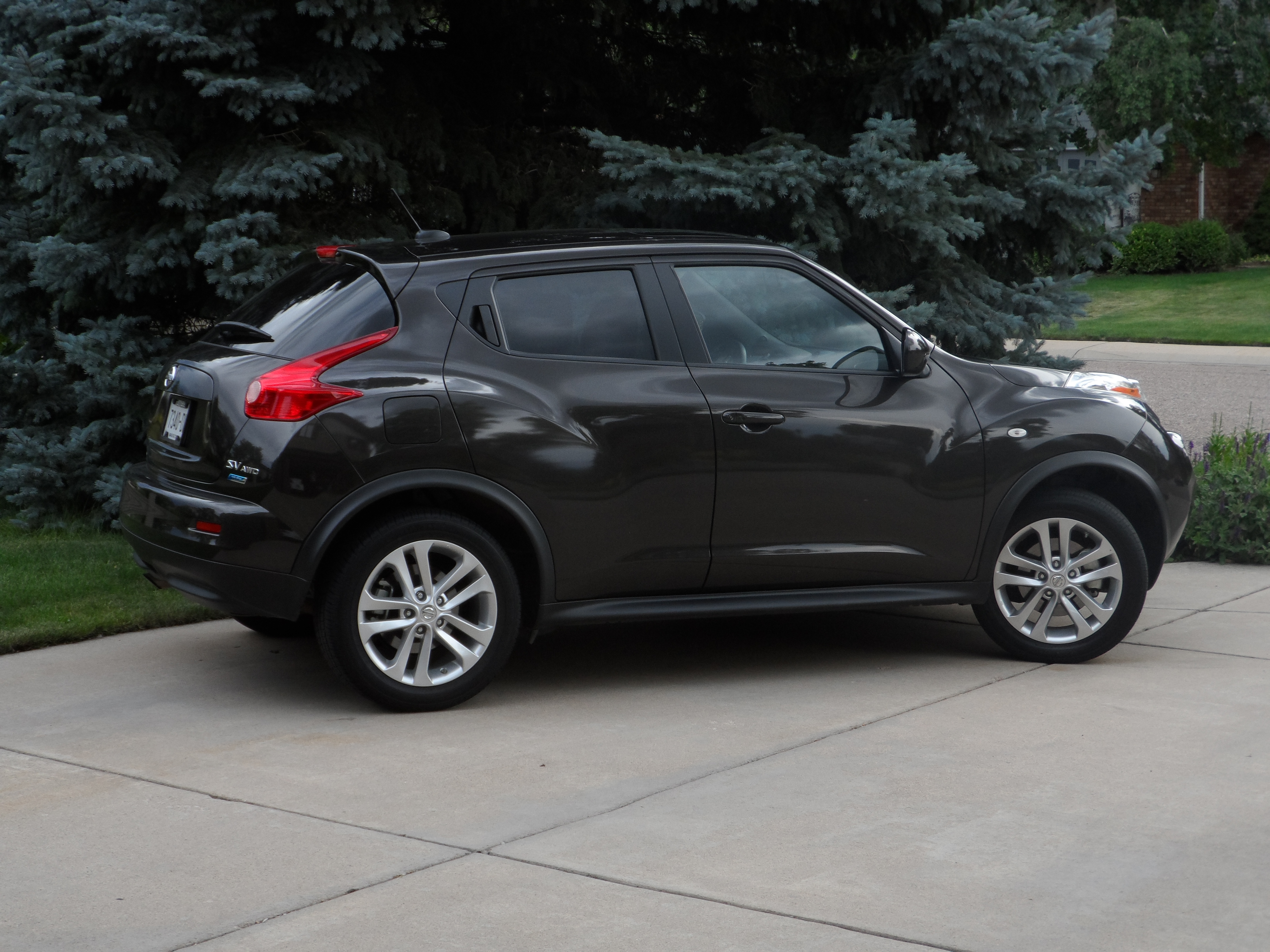
2012 Nissan Juke SV AWD

Juke SV

    The word “juke” has multiple meanings, but in sports parlance, to juke is to feign or fake out, as for instance a running back might do.  I suppose that is what Nissan had in mind when naming the mini-crossover that they introduced in 2010.  I had one last week to test, a 2012 “SV” all-wheel drive model that came in metallic bronze (dark brown).  Nissan manufactures the Juke in their plant in Oppama, Japan, for the North American market.  Sales figures for the Juke have exceeded the company’s expectations since inception and in June of this year sales were up 52.7% from the same month in 2011.

The Juke is a five-passenger four-door sedan with interesting styling that resembles a frog on wheels.  Parking lamp lenses poke up from the front fenders and into the driver’s view and look pretty cool after dark.  The taillight lenses are visible in the mirrors, as well.  No excuses for driving around at night with a light out in this car!  Speaking of which, another two round headlights are located in the front fascia, rally-car style.  The Juke has a two-door appearance with the rear door handles installed on the C-pillars, a Nissan custom.  Room in the fold-down back seat for three is adequate for all but large adults, and trunk room is 11 cubic feet.  The Juke styling puts somewhat of a restriction on both trunk space and rear seating capacity.

M.S.R.P. of the Juke SV is $23,230, and optional floor mats and freight bring the total to $24,165.  With the SV the owner gets a power moonroof, premium speakers, upgraded cloth seating, keyless entry, pushbutton starter, satellite radio, power windows (4), tilt/telescope, and I-CON.  That last item is Nissan’s Integrated Control system, a dashboard display that provides control and observation of turbo boost, mileage data, climate settings, and, well, everything but navigation directions.  The hand brake is on the console, which is painted like the outside of the car and shaped so that it resembles a motorcycle gas tank.  The shifter is on there, and it controls a continuously variable automatic transmission.  That is all you can get with all-wheel drive, and it is coupled to a 1.6 liter, four cylinder, turbocharged engine.  Horsepower is 188 and torque is 177 lb. ft.  It’s a good power plant, and the transmission is, shall we say, acceptable.  I do like that it allows manual shifting, and that is what I employed on my trip to Vail.  I didn’t care for the turbo lag, but it goes pretty good when spooled up.  Mileage ratings are 25 city and 30 highway, and I averaged 29 mpg during the week.

The Juke all-wheel drive system has torque-vectoring, a nice feature that splits torque up to 50/50 between the front and rear axles, plus it distributes torque from side to the side at the rear axle.  All this makes the Juke handle great, as do the Goodyear Eagle RSA P215/55R17 high performance radials mounted on ten-spoke alloy wheels.  Wheelbase of the 162” car is 99.6”, and the weight is 3,170 lb.

Nissan figured the Juke would sell to male shoppers, but as it has turned out females dominate the purchases – Nissan is happy with the sales, period.  I think the buyers are pretty happy, too.

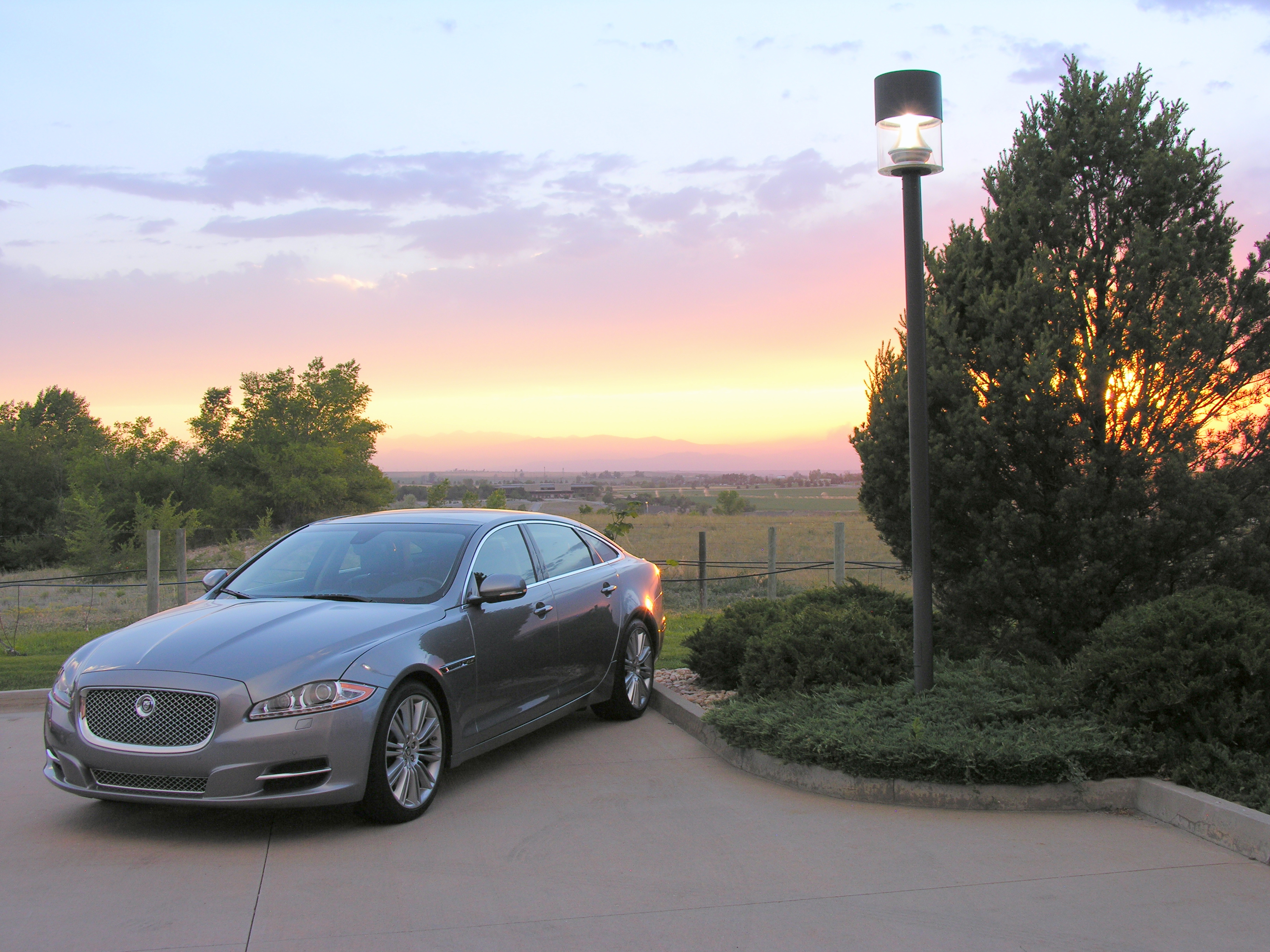
2012 Jaguar Supercharged XJL Sedan

Jaguar @ GGH II

    I received my 42nd new car for review this past week, and it was a big one, the 2012 supercharged Jaguar XJL long-wheelbase rear-wheel drive sedan.  It came with jet black leather interior and the paint was an out-of-this-world Lunar Gray metallic.  It presented quite an imposing image setting out in the driveway of my house.  And by big, I mean a wheelbase of 124.3”, or over TEN FEET!  Through extensive use of aluminum construction, this 206.6” long elegant British beast only weighs in at 4,323 lbs.

Beautiful Jaguar XJ saloons (sedans) came out in 1968, and by 1972 were available in long-wheelbase configurations and with 12-cylinder engines. That year the company even included air conditioning as standard equipment (gasp!).   These XJ’s had notable styling and two fuel tanks with filler caps at the forward corners of the trunk lid.  The styling of the car represented the final link in that department with the company’s founder, Sir William Lyons (“Mr. Jaguar” 1901-1985).  Up front the XJ (eXperimental Jaguar) saloons at that time had four distinctive headlight nacelles to enhance the styling mystique.

The current XJL that I got to test was the new style car introduced in the summer of 2009 at the Saatchi Gallery in London, complete with Jay Leno and Elle MacPherson on hand for glitz.  When you’re talking about style, you’re talking about Jaguar, all the way back to that 1968 XJ, which while I was in college was the prettiest four-door sedan on earth.  The way people in Greeley reacted this past week in streets and parking lots, I suspect not much has changed for the Big Cat.  The only disparaging remark that I heard was a complaint about the lack of a “leaper”, made out of chrome and mounted on the hood.  And while on the topic of looks, I’ll mention that I thought the black, glossy C-pillars joining the back glass with the rear door windows was an OK styling queue.  The grill…….Oh Boy!

The M.S.R.P. of $94,175.00 included an “illumination package” for $1,700.00, freight, and the base of $91,600.00 for this supercharged model.  A “Supersport” model with 510 horsepower is $26,000.00 more and a naturally-aspirated, 385 horsepower model can be had for $11,000.00 less.  In the middle of their lineup, therefore, was the V-8 powered car I drove with 470 horsepower and 424 lb. ft. of torque.  It is mated to a six-speed automatic transmission.  Zero to 60 acceleration is reportedly 4.9 seconds with a top speed of 155 mph.  I mentioned last week reaching 115 mph at High Plains Raceway in a car – well, it was this car.  It handles very nicely on the track with its Dynamic Stability Control, calculating the appropriate suspension response 500 times per second to keep it flat and stable.  Wheels are 20” Kasuga alloys with  ten double spokes, fitted with Dunlop 255/35ZR20’s.

Inside the Jag, leather is everywhere, or so it seems.  The front buckets can give your back a massage, and they cool and heat, as well.  The gauges are “virtual”, like a laptop screen, with “torch” feature on the tach and speedometer.  It’s like a flashlight shining on the speed you’re going at that instant.  The supercharged XJ has tray tables on the back of the buckets, and a 1,200 watt, 20-speaker Bowers & Wilkins “rock-crusher” stereo.  The automatic transmission gearshift is a round, chrome knob that rises out of the console when you fire up the car.  I kept hitting the ignition when friends entered the car to show it off.

On balance, the Jaguar is an attractive, high-performance, luxury sedan, and if you’re in the price-point area code, it deserves consideration.  I enjoyed my week with the Big Cat, and hated to see it go.

2012 Toyota Hybrid XLE

2012 Camry Hybrid

Toyota’s Camry Hybrid mid-size sedan has been available since 2006, and is currently available in its second generation configuration as a 2012 model.  Such a car was delivered to my house last week for testing, and it was loaded to the tune of $34,547.00, M.S.R.P.  The base price of $27,400.00 for the XLE model had as additions the blind spot monitor ($500), safety connect package ($450), leather package ($1,160), premium navigation/electronic package ($2,600), moon roof ($915), and wheel locks ($67).  It came in “cosmic gray mica” paint and the leather seating was a light gray in color.  It’s a five passenger sedan with a decent sized rear passenger compartment and a 13.1 cubic foot trunk.  It comfortably seats five adults.

I drove the Camry quite a bit this last week, both to Ft. Collins and to Denver, and gradually grew pretty accustomed to the CVT transmission setup in the car.  CVT stands for continuously variable transmission (no shifts), and it is coupled to a gasoline 4 cylinder, 2.5 liter motor with 156 horsepower and 156 lb. ft. of torque.  Two electric motor/generators are on board to add in 141 more horsepower and 199 lb. ft. of torque.  Combined power rating is 200 horsepower, and as I mentioned, it was pretty suitable for driving the somewhat big sedan.  I liked the ride and handling better than last Camry I had, and styling is great front and rear, OK from the side.

Fuel economy for the hybrid has been improved for 2012, by some estimates a full 12 mpg. Ratings for the car I drove were 40City and 38Highway. The current mileage compilation for the car is displayed on a dial; not digitally. When the car was picked up I notated 38 mpg for the miles I drove it. Overall, not that bad.

I mentioned earlier the packages on board with this Camry – it was equipped like a full blown luxo sedan. Good JBL stereo, 7″ touchscreen for nav and backup, fancier dash materials for 2012, perforated leather seat inserts, blind spot monitor, satellite radio, 17″ alloys, and Bluetooth.

There is a reason the Camry is America’s best selling car, and I experienced it this week with the Hybrid. This Hybrid model with its increased economy will be chipping into Prius sales, as I see it… and into the competition’s.

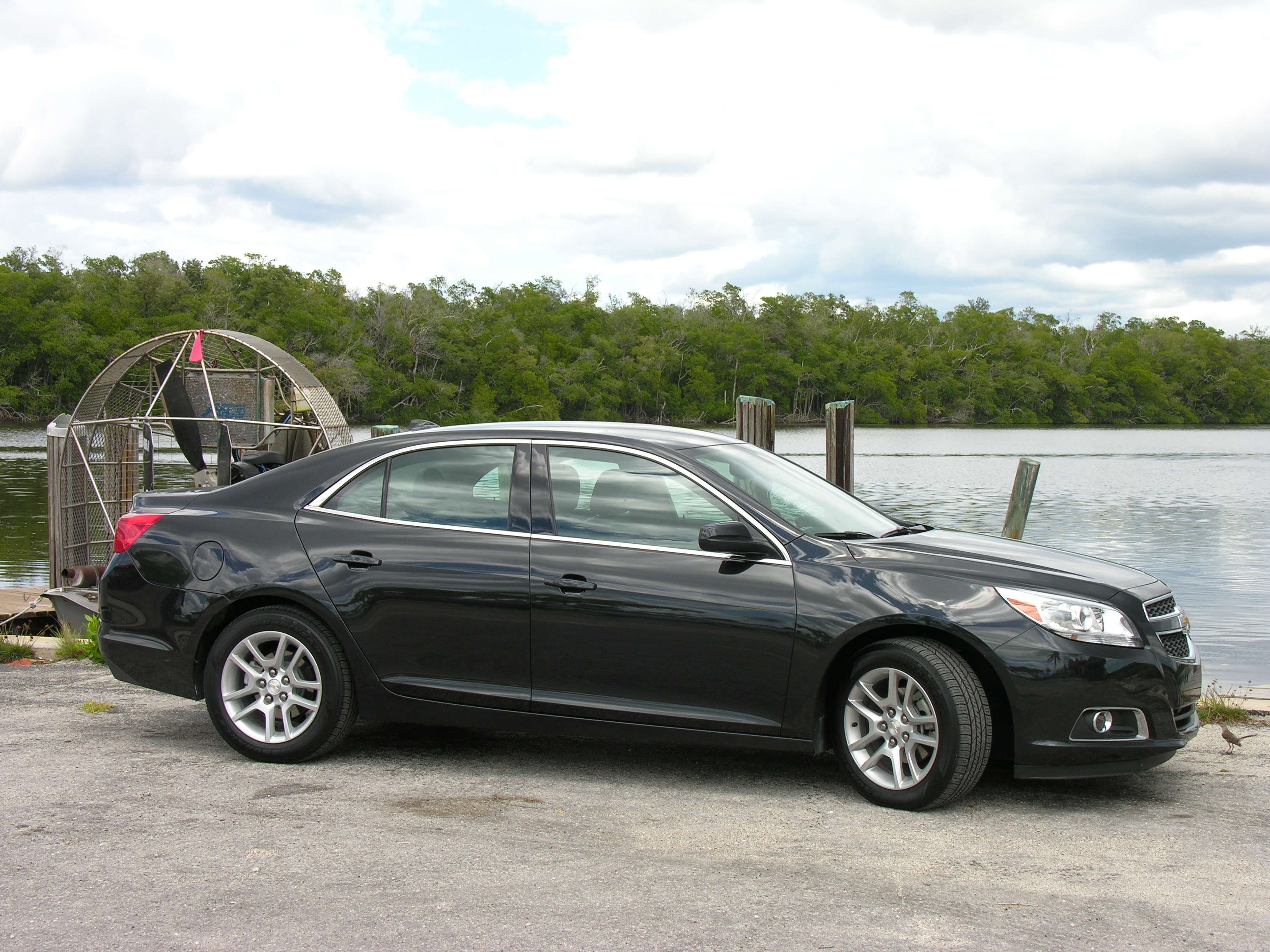
“American Pie” 2013 Chevy Malibu Eco

2013 Malibu Eco

Don McLean’s magnum opus (best work), “American Pie”, was written and performed in 1971, thereafter becoming the No. 1 U. S. hit and staying in that position for four weeks during 1972.  When asked, years later, what “American Pie” means, McLean responded that it “means I never have to work again.”  The song’s lyrics bring out McLean’s life story through the idealized 50’s and on to bleaker 60’s – and two deaths; Buddy Holly’s (1959) and America’s innocence (JFK assassination in 1963).  Several deaths, more accurately, because Richie Valens and The Big Bopper died along with Holly, and John Kennedy’s brother Bobby was assassinated in 1968, as was Martin Luther King that same year.  With the overhang of Viet Nam and the college campus unrest, even the glorious Apollo 14 moon landing in February of 1971 failed to lift America’s, or McLean’s, spirits.

“American Pie” contains lyrics that are dissected even to this day; lyrics such as “I can’t remember if I cried, when I read about his widowed bride, but something touched me deep inside, the day the music died”.  He’s referring to, of course, Buddy Holly’s death on February 3rd, 1959, in a plane crash in Iowa.  And that also accounts for the lyrics “but February made me shiver” in the first verse.  Analysts are less certain, however, of what McLean meant by “the three men I admire most; the Father, Son, and the Holy Ghost”.  The three performers that perished on that plane?  JFK, Bobby, and MLK?

One thing is certain, though, and it’s that “Drove my Chevy to the levee” is in every chorus, and that the levee (in the song) was dry in every instance.  I was in Florida last week driving a 2013 Chevy (Malibu Eco) to the levee; several levees, in fact.  They sure weren’t dry, as the Miami area received ten inches of rain in the two days I was driving around with my latest test car.  Earthen levees protect Broward and Dade counties in South Florida from waters that come out of Lake Okeechobee in Central Florida, the seventh largest freshwater lake in America that serves as the headwaters to the Everglades.  Approximately 1.5 billion gallons of fresh water ooze out of southwest Florida into the ocean each day – wouldn’t that be nice to have in Weld County?

I didn’t just drive the Chevy to the levee last week; I also attended two Marlins/Rockies games and drove the car to Everglades City on the Gulf of Mexico.  The Chevy Malibu Eco proved to be quality transportation, and is the only 2013 Malibu currently for sale.  Two more powerful four cylinder Malibu’s will be available in a few months, one with a turbocharger.  The Eco is electrically assisted, with a 15 kilowatt motor-generator providing the assist.  One might call it a “hybrid hybrid”, because the car cannot get by on electric power alone.  Transition from electric power to gasoline (2.4 liter L4, 182hp with a six speed automatic) is not as smooth as a Chevy Volt, but this car is bigger than a Volt and much less expensive.  Mine was metallic black with black leather interior and listed for $28,632.00, as equipped.  Pretty much all luxury options were present, with the exception of navigation system (it has OnStar, though) and a moon roof.

Wheelbase is shorter than last year’s Malibu at 107.8”, but length is about the same at 191.5”.  Mileage estimates are 25city/37highway, and the tank holds 15.8 gallons.  The trunk is a battery-restricted 14.3 cu. ft., but I had no particular problems with my luggage.  Ride and handling are suitable.

I had no quibbles with the styling of the 2008/2012 Chevy Malibu (I own one), but do not think this 2013 model suffered a setback in this department.  It is a beautiful mid-size automobile, and provided a nice ride to the levee, even though the levee was very wet.  The Marlins rained on the Rockies’ parade, as well, winning both contests.2013 Malibu in Everglades

“Little Things” 2012 Volvo XC70 T6 AWD Wagon

Volvo XC70

    Bobby Goldsboro is a well-known singer-songwriter to me, but I didn’t know he was THIS well-known.  THIS man had eleven top-40 U. S. Billboard Hot 100 hits, and twelve on the country charts.  The Florida native that once played guitar for Roy Orbison broke onto the scene by himself in 1964 with his first big hit, “See the Funny Little Clown”.  His biggest hit of all was brought out in 1968, and it was a honey, named “Honey”, his first country hit that reached number one, both here and in Australia.  Bobby remained a country music fixture well into the 1980’s.

I graduated from high school during the year of 1965 and spent it driving around listening to radio station KOMA in Oklahoma City, where I heard Bobby’s top single that year, “Little Things”.  Little things are what I enjoyed about the test car for this past week, the 2012 Volvo XC70 T6 AWD station wagon.  Not overwhelming with regards to power or styling, the little (little?) wagon just kind of grows on you while you tool around from place to place.  The Volvo has a window sticker that totals $49,070.00 with about $10,000.00 worth of optional equipment.  Thus, it has navigation system, great satellite stereo, Bluetooth, tilt/tele, heated seats front and rear, backup camera, turning headlamps, leather throughout, roof rack, moon roof, power tailgate, 18” alloy wheels, blind spot alert, park assist, pushbutton start, ground lighting at the doors, and dual zone climate control.

Power is supplied for the Volvo by an in-line 6 cylinder, 3.0 liter, turbocharged alloy engine with 300 hp and 325 lb. ft. of torque.  A six-speed Geartronic automatic transmission backs it up and is coupled to an all-wheel drive system. EPA mileage estimates are 17city/23highway, but I got 24.1 mpg on a round trip to Denver. Wheelbase is 110.8” and overall length is 190.5”, with the weight coming in at 4,152 lbs.

The Volvo I drove came in Twilight Bronze metallic, and coupled with the charcoal cladding all over the wagon, it was an appealing look.  Inside the leather seating was chocolate brown, but a lot of almond-colored trim was on hand to give it a splendid look.  I counted five colors on the dashboard – the two already mentioned, plus gray, silver, and woodgrain.  Dual exhaust finishers peeked out from under the rear bumper, and the roof rack had a massive, functional, look.

While in Denver, I loaded the vehicle with five, big hungry holiday diners, and the ride was suitable with all on board.  The acceleration of the XC70 is great, reportedly zero to sixty in about seven seconds.  And I understand the top speed is 130 mph.

What “little things” did I like?  -The stitching on those yummy brown leather seats.  -The tall taillights affixed at the rear corners of the car.  -The cross mounted in-line six providing additional protection in case of a head-on.  -The multifunction stalks on each side of the steering wheel.  -The Zephyrus 18” alloy wheels.  -Rear headrests that flop down at the flip of a switch (on the dashboard) for visibility.  -The Xenon headlamps that peek around the corner.  I could go on and on.

I give the Volvo a thumbs up for the enjoyable week that I had the car.  It could provide years of enjoyment for someone, just like Bobby Goldsboro did.

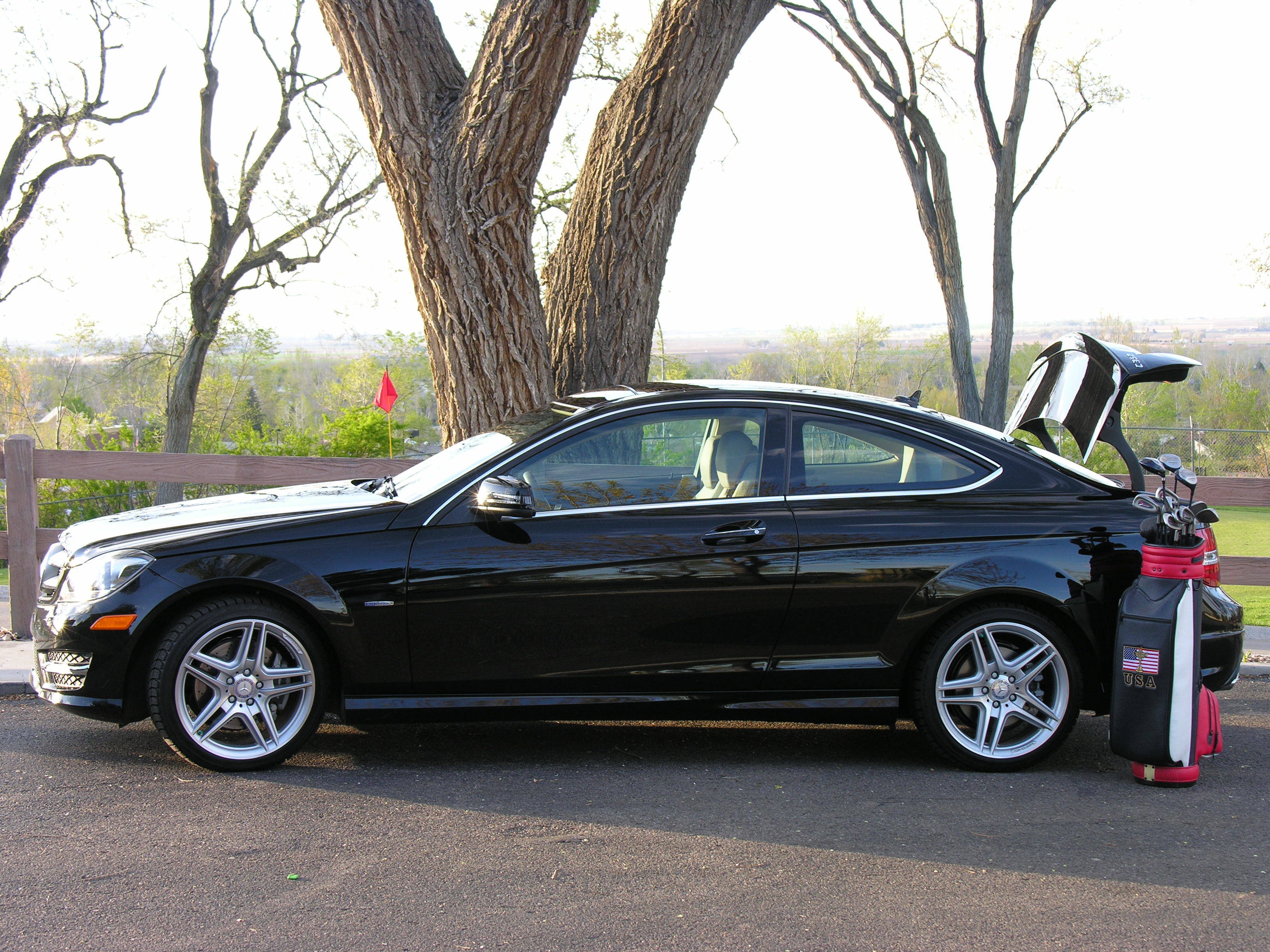
2012 Mercedes Benz C350 Coupe

M-B 350C

I left the hyphen out of the brand name of the car I drove last week because that is what Janis Joplin did when she wrote, and titled as such, her final song in 1970.  Her lyrics read “Oh, Lord, won’t you buy me a Mercedes Benz?”  In the hit, she also made requests for a color TV and a “night on the town”, but seemed to emphasize her desire for the car with two verses that alluded to the brand.  Mercedes-Benz, the car, has a hyphen, but it’s pretty evident what Joplin wanted when she recorded the tracks on October 1st of that year.  They were the last ever recorded by her, because she died on October 4th, 1970, at age 27.  In 1971 she became one of only two artists in rock and roll history with a posthumous number one U. S. singles hit.  It was her only such hit, “Me and Bobby McGee”, and Otis Redding was the other artist with “(Sittin’ On) The Dock of the Bay”.

The Mercedes-Benz brought to me last week was the rear-wheel drive C350 Coupe with a 3.5 liter, 302 horsepower V-6.  Engine torque was 273 lb. ft., and a seven speed automatic transmission was bolted to the power plant.  At our altitude, zero to sixty acceleration time is 6.5 seconds, and at sea level that number is reduced one half second.  Top speed is reportedly 155 mph.  Handling and manners on the highway were superb – in fact, I liked this car out on the road like no other.  It had upgraded Bridgestone 225/40R18 Blizzak LM60’s on 18” ten spoke AMG alloy wheels – part of the “Advanced Agility Package” on the car that added $1,400 to the M.S.R.P.  Other add-ons included backup camera, service package, keyless entry, lighting package, lane tracking radar, and nav/radio/Sirius stereo (including weather radio) that together put $5,090 onto the sticker.  Those items plus freight brought the total to $49,735.00, and the car came standard with a large panoramic moon roof.  Wheelbase on this car was 108.7”, length – 180.7”, width – 69.7” and the weight was 3,497 lbs.

Mercedes likes to say that the interior of the C350 has a “lounge atmosphere”, and it IS nice.  Access to the back seat on this two-door is OK, and all four passengers get to sit in a full almond leather bucket seat.  The dashboard has a little retro look to it, with the navigation screen incorporated in the center.  With the radio on, a needle is moved back and forth for tuning it, like one in an old pickup or something.  It’s kind of cute.  The trunk holds 12.4 cu. ft. of cargo and the trunk lid has a good looking spoiler attached.

Styling of the Coupe is top notch, with big BI-Xenon headlamps that include the active curve illumination feature.  The car has sport body styling fascia down the side and dual exhausts with chrome finishers at the rear.  It has the B-pillars on the side of the car with back windows that don’t roll down.  That’s pretty much the standard nowadays, but I remember the first time that I saw such a car (a ’73 Pontiac Grand Am), I wasn’t so forgiving.

Back to Janis Joplin; another hit of hers that comes to mind is “Piece of My Heart”, from 1968.  She at that time was a member of Big Brother and the Holding Company.  Moments ago someone other than myself drove off in the Mercedes C350, and I think the car took a little “piece of my heart” with it.

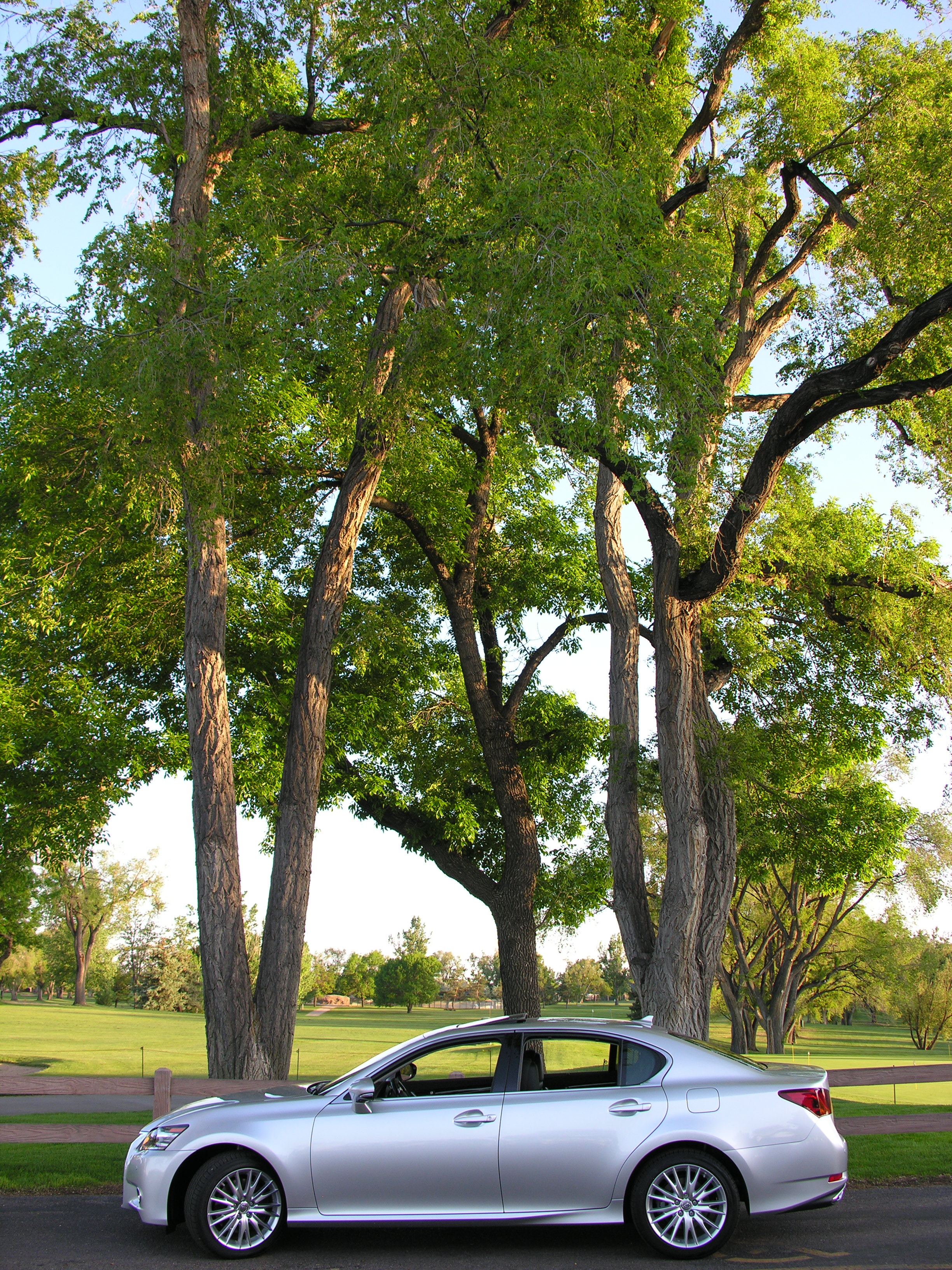
2012 Lexus GS350 AWD Sedan

2012 Lexus GS350

Lexus, Toyota Motor Corporation’s luxury car division, has been producing GS series automobiles since 1993.  The GS lies in the middle of the Lexus sedan lineup, between IS at the bottom and the LS series at the top.  It is in the 4th generation configuration, having been introduced in February of this year.  Three GS Lexus models are offered, or will be, including the GS350 that I drove this week.  The other models are the GS350F and the forthcoming GS450h, a performance hybrid (later this year).

The GS350 that I tested had an all-aluminum V6 (3.5 liter) with 306 horsepower and 277 lb. ft. of torque.  It is mated to a six-speed sequential-shift automatic transmission that includes paddle shifters behind the steering wheel.  It is an all-wheel drive, five-passenger sedan with wheelbase/length/weight numbers of 112.2”, 190.7”, and 3,795 lbs., respectively.  Zero to sixty acceleration is reportedly 5.6 seconds with a top speed of 144 mph.  Fuel economy ratings are 19/city and 26/highway with a 17.4 gallon tank.  Classified as a mid-luxury class performance sedan, the car is really attractive, particularly from the front and the rear.  Each side of the car could use a little more chrome (my favorite finish), as most everything there is painted silver.  But it is nonetheless a stunner, and I noticed it getting a lot of looks around town.

My Lexus came in Liquid Platinum silver metallic paint and the leather interior was black.  The rear armrest was as extensive as I have ever seen, with seat heat and air conditioning controls in the armrest as well as radio buttons, rear window shade control, and of course, the cup holders.  Oh, and don’t forget some storage, as well.  The front buckets are sumptuous, with 18-way power (Eighteen!) capability.  And while on the topic of numbers, how about that split-screen 12.3” multimedia display in the center of the dashboard?  Rear backup camera, navigation, 835-watt stereo, console mouse – all on hand.  I enjoyed the mouse for controlling, well, just about everything electronic.

The GS rides on 18”, split-nine spoke silver alloy wheels fitted with 235/45R18 Dunlop Sport S100’s.  High-toned stainless exhaust finishers extend out from under the rear fascia and on the front of the car are Bi-Xenon Hi-Intensity Discharge headlamps, plus fog lights.  The M.S.R.P. of the Lexus was $61,212.00, and that included the blind spot monitor ($500), Luxury package ($6,350), stereo upgrade ($1,380), navigation package ($1,735), intuitive park assist ($500), floor mats, and freight.

Driving the brand new Lexus was certainly a pleasure, as I headed out to I-25 for a ride to Ft. Collins.  The ride is adjustable with a knob on the console – actually four settings – normal, ECO, Sport S, and Sport S+.  With the two sport settings the driver gets suspension, steering, shifting, and throttle modifications – plus the gauge cluster gets a red lighting surround effect.  All this makes the console quite busy, but nicely thought out.  Both it, the dashboard, the door panels, and the rear armrest are sprinkled with controls.  But all the gadgets added to, rather than subtracted from, the overall GS350 experience, making it a “recommended” vehicle on my list.